Short answer
Fine black dust in a fuel filter, on a boat with a built-in tank, can come from a charcoal (carbon) canister on the tank vent line that has soaked up liquid fuel and is breaking down. The dust washes into the tank and fouls new parts all over again after each repair. We have seen it once in 959 fuel jobs since 2013, so it is not common, but it took four visits to find. Rule out the fuel line and the fuel itself first, then have someone trace the vent line.
What the canister is and why your boat has one
A fuel tank has to breathe. As fuel goes out, air has to come in through the vent, and when the tank warms up or you fill it, fuel vapour goes out the same way.
Many boats with a built-in tank built since about 2012 have a canister of activated charcoal spliced into that vent hose to meet emissions rules. The rules arrived in the United States first and in Canada a few years later. The charcoal soaks up fuel vapour before it leaves the boat.
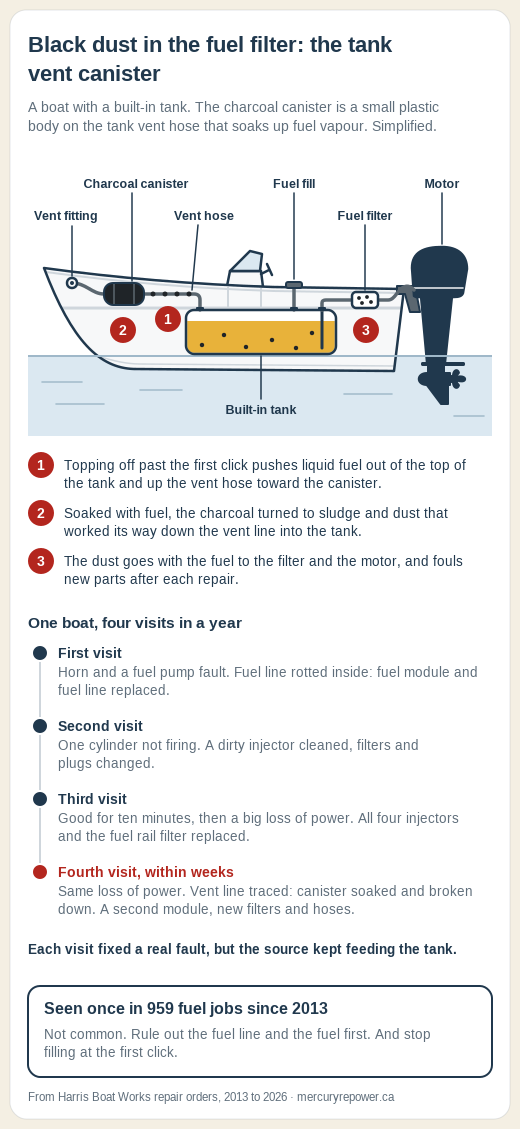
It is built for vapour. Liquid fuel is never supposed to reach it. When it does, the charcoal can saturate, and on the boat we saw it had broken down into black sludge and dust fine enough to pass the mesh screens in the fuel system.
Portable tanks do not have one. Some boats meet the rules another way, so a newer boat is not proof you have a canister. You have to look.
The boat that came back four times
One boat came back to us four times in a year. Every visit found a real fault and fixed it.
- First visit: a warning horn and a fuel pump fault code at higher RPM. The fuel line from the tank had broken down on the inside, there were pieces in the high-pressure filter and the pump was not working properly. We replaced the fuel module and the fuel line.
- Second visit: one cylinder not firing. Swapping injectors moved the miss, so it was a dirty injector. It was cleaned, and the filters and plugs were changed.
- Third visit: good for ten minutes, then a big loss of power. All four injectors and the filter in the fuel rail were replaced.
- Fourth visit, within weeks: the same loss of power.
On the fourth visit the techs found fine black particles all through the fuel system. They ran the motor on the shop's own clean fuel and afterwards found the same dirt in the shop's fuel line, which told them the motor's own fuel system was holding the dirt and moving it around.
Then they traced the tank vent line from one end to the other and found a small charcoal canister spliced into it. It was soaked through with fuel. The charcoal inside had turned to sludge and dust. Their conclusion was that the broken-down charcoal had been working its way down the vent line into the tank, and the vent line was the only source they found.
That is why the earlier repairs did not last. Each cleaned up the damage while the source kept feeding the tank. The rotted fuel line on the first visit was a real second source, and replacing it was right. It just was not the only one.
Signs it might be the canister
None of these proves it on its own. Together, on a boat with a built-in tank, they are worth a look at the vent line.
- Fine black dust or sludge in a fuel filter. Rotted hose liner usually comes out as flakes, and on a lot of hoses the liner is clear plastic, so it will not always show as dark specks. Fine black dust is a different look.
- The same fuel fault coming back after good repairs. New parts that only last a few weeks, the way the injectors did on the boat above.
- Trouble filling. Owners elsewhere have written about canisters behind slow fills, fuel spitting back at the nozzle and a tank that pulls a vacuum. If air rushes in when you crack the cap, the tank was pulling a vacuum. Do not run the boat with the cap loose.
- A fuel smell after filling. Any fuel smell in a boat is worth finding, canister or not.
In marine forums and the makers' bulletins we found owners describing filling problems with canisters, but nobody else describing canister charcoal getting into an engine. That does not mean ours was the only one, only that most techs would not think of it.
Why topping off is the problem
The first click at the pump is the nozzle telling you the tank is full. Every squeeze after that pushes liquid fuel up toward the vent, and the canister sits on the vent. The canister makers' own instructions say liquid fuel must not reach it, and topping off is how it gets there.
So stop at the first click, even if it means not rounding up to the dollar.
What you can check without opening anything
You can do all of this with the motor off and nothing taken apart.
- Is the tank built in? If you run a portable tank, this page is not your problem. Look at the fuel line and the fuel itself instead.
- Find the tank vent. On many boats it is a small fitting on the outside of the hull, though boats differ. Follow the vent hose from the inside as far as you can see it without taking panels off. A canister is a small plastic body with the vent hose going in one side and out the other.
- Watch the next fill. Stop at the first click and notice whether it fills slowly, clicks off early or spits back.
- Ask about the filter. Whoever changes your boat's water-separating fuel filter can look at what is in it. Fine black dust is the thing to mention.
If you change that filter yourself, treat it as fuel system work. Engine off, battery disconnected, outside and away from anything that sparks, with a rag and a container to catch fuel. Wipe up spilled fuel and let the area air out before you reconnect the battery. On Mercury EFI FourStrokes, 60 hp and under prime with the bulb and 75 hp and up prime themselves at key-on; check your owner's manual if unsure. Look for leaks before you start the motor and again once it runs.
Leave the canister, the vent hose connections and anything on the engine side to a shop. Never open a fuel-injection line yourself.
What the fix involved
On that boat the fourth visit included a second fuel module, because the dust was lodged in the engine's own fuel system. It also included new fuel filters, several of the fuel hoses on the motor, a water-separating filter added on the boat side, and fresh fuel. The follow-up plan was to check that filter element after more running, since leftover dust would show up there first, and to check the fuel filters at every service after that.
A canister that has soaked through and broken down is done. What goes in its place depends on the boat, so have that conversation with your shop before any work starts.
What it costs
Fixing the wrong thing: on the boat above, four visits in a year covered two fuel modules, injector work, filters and hoses. That adds up quickly. A complete fuel module alone, on the 2015 and newer 75 to 150 hp motors, came to $1,700 to $2,450 on the three customer-paid jobs with a complete bill on file.
Finding the cause: tracing a vent line is labour, not parts. On fuel complaints since 2024 where no parts were needed, the time spent looking has cost about $125 to $210. We have only had the one canister case, so we do not have a range to give you for the canister itself.
If it turns out to be the fuel line instead: typically $275 to $600.
These are totals our customers paid, parts and labour, before tax, on jobs from 2024 to 2026. Prices change, so treat these as a guide and not a quote.
If it is not the canister
Far more often, dirt in a filter is something else. Since 2013 we have replaced 39 fuel lines that were breaking down on the inside, and found water or old fuel on 270 jobs. A fuel pump that came apart inside can also leave pieces behind. A loose pickup tube or a stuck valve at the tank is a different problem: it starves the motor of fuel, so it gets checked on the same visit. The order our techs check these in is in our guide to a Mercury that bogs down under load.
What to tell us when you book
Tell us whether the tank is built in, what was done on earlier visits and by whom, whether anyone saw black dust in a filter, and how the boat behaves when you fill it. On a repeat fuel problem, that history helps the tech get to the vent line sooner.
We are Harris Boat Works, on Rice Lake in Gores Landing, Ontario. Service requests are at hbwservice.ca.
The counts on this page are from our own repair orders, December 2013 to November 2026.
Sources
- HBW service records review, November 2026: technician notes on 959 fuel-system repair jobs, December 2013 to November 2026, classified by what was found and fixed. The canister case is a single boat. Costs are from 2024 to 2026 jobs, parts and labour before tax (no customer data used)
About the author
Jay Harris runs Harris Boat Works, a family marina and Mercury dealer on Rice Lake in Gores Landing, Ontario. The repair counts and costs on this page come from the shop's own work orders.
