Short answer
If an outboard that ran fine last fall now sputters, stumbles when you give it throttle, or quits and will not restart, look at the fuel before you look at the motor. Water or old gas is the most common thing our techs find on any fuel complaint: 270 repair jobs since 2013, on everything from 9.9 kickers to 250s. Checking takes ten minutes and a glass jar. Fixing it has typically cost $300 to $700 before tax.
Symptoms of water or old fuel
There is no single symptom, which is why it gets blamed on everything else. These are the ways it showed up on our jobs:
- Rough or sputtering within minutes of the first launch
- Fine at idle, stumbles or bogs when you push the throttle
- Runs on some cylinders and not others
- Quits and will not restart, sometimes with a water-in-fuel alarm on motors that have one
- Ran perfectly in September, will not run properly in May
More than half of those 270 jobs named water specifically. Most of the rest were fuel that had simply sat too long.
If you think there is water in the fuel, stop running the motor and stop cranking it. Every turn pulls more of it through the filters, the pump and the injectors.
The 10-minute sample test
You need a clean glass jar and a spot outdoors, away from anything that sparks or burns. Plastic cups go cloudy in gasoline and fool you. Do it with the motor off and cold.
Where the sample comes from depends on the boat:
- Portable tank: tip it so the fuel runs to one corner and draw from the bottom with a hand pump. Never start a siphon by mouth.
- Water-separating filter with a drain: open the drain into the jar.
- Spin-on filter with no drain: only when you are changing it anyway, and only if it is out in the open where you can catch every drop. Close the fuel shutoff if the boat has one, unscrew the filter upright over a pan, pour what is in it into the jar and fit a new filter. Do not put the old one back on. If it sits down in an enclosed bilge, leave it to a shop.
- Built-in tank with neither: that is as far as an owner should go. Do not siphon or pump a built-in tank at home, and do not open a fuel line on the motor. Fuel-injected motors hold pressure in those lines.
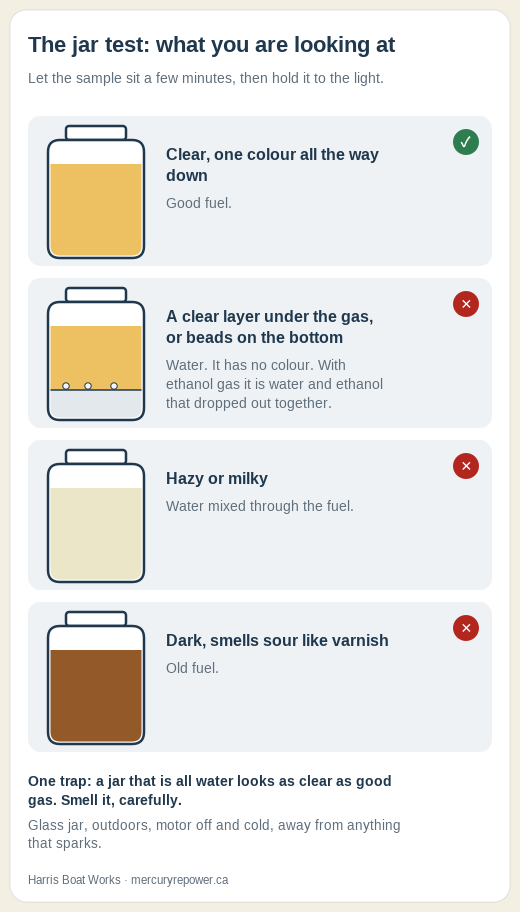
Let the jar sit for a few minutes and look at it against the light.
Good fuel is clear and one colour all the way down.
A line with a separate layer under the gas, or beads on the bottom, is water. With ethanol-blended gas it is water and ethanol together, which have dropped out of the fuel.
Hazy or milky fuel has water mixed through it.
Dark fuel that smells sour, more like varnish than gasoline, is old.
One trap: a jar that is all water looks as clear as good gas. Smell it, carefully. If it does not smell like gasoline, it is not.
If you find any of those, do not top the tank up and hope. Fresh gas on top of bad gas gives you a tank of slightly better bad gas. It has to come out. A portable tank you can empty yourself. A built-in tank is a job for a shop with the right pump, because the wrong one near gasoline is how fires start. Old fuel, including mixed two-stroke fuel, goes to your municipal household hazardous waste depot. Do not pour it out.
How the water gets in
On our repair orders the sources were ordinary:
- A fuel cap that was cracked, or missing its O-ring
- A broken tank vent that let rain and spray in
- A failed gasket or fitting on top of a built-in tank
- Fuel that had been sitting since the previous season
Ethanol is part of the last one. It absorbs moisture from the air, and once the fuel is holding all it can, the water and ethanol drop to the bottom together.
In Ontario, fuel suppliers have to average 11 per cent renewable content, mostly ethanol, in the gasoline they sell. That goes to 13 per cent in 2028 and 15 in 2030. The rule lets them leave mid-grade and premium out of that average, which is why some stations' premium has no ethanol in it. Not every station's does, and brands change. Read the label on the pump you are standing at. Mercury approves fuel with up to 10 per cent ethanol and nothing stronger. There is more in our Ontario ethanol and octane guide.
Once fuel has taken on water and separated, no additive turns it back into good fuel. Mercury says the same. Stabilizer protects fresh fuel that is stored properly. That is all it does.
If the sample is clean, check the boat side next
If the fuel is good and the motor still starves, the problem is often in the boat and not the motor.
A fuel line that is rotten on the inside. We have replaced 39. The outside of the hose looks fine and it will pass a test at idle. Inside, the liner is breaking up. Older grey hose has the worst reputation for it. The liner is often clear, so look for flakes or crinkled strips in a filter or in the primer bulb.
A stuck valve at the tank. Many built-in tanks have an anti-siphon valve at the fitting. When it sticks it can restrict the flow, and the motor starves at speed. Do not remove it or gut it. It is a safety part and it belongs there.
A pickup tube or vent problem. A loose pickup draws air. A blocked vent makes the tank pull a vacuum.
The way to separate boat from motor is to run the motor on a different tank and hose. Our techs do it with a shop tank. If the motor is happy on ours and not on yours, nobody needs to take the motor apart.
What the repair involves, and what it costs
It depends how far the bad fuel travelled.
Caught early: drain or pump out the fuel, change the filters, flush the lines, refill, test.
Run for a while on bad fuel: the same, plus draining and cleaning the fuel reservoir on the motor (the vapour separator or fuel supply module on a fuel-injected Mercury) and sometimes cleaning injectors. On a motor with a carburetor, it usually has to come off and be cleaned.
On 63 of these jobs since 2024, our customers typically paid $300 to $700 for parts and labour, before tax, with a median around $450. A quarter of them ran higher, mostly where the bad fuel had already damaged parts or other work was done on the same visit. Carburetor cleaning on small motors has typically run $285 to $525. Prices change, so treat these as a guide and not a quote.
A routine that prevents most of it
In the fall:
- Treat fresh fuel with stabilizer, then run the motor for ten minutes so the treated fuel reaches the motor's own fuel system. That is Mercury's storage advice.
- Leave a built-in tank nearly full.
In the spring:
- Do not start the season by pouring in last year's jerry can. Stabilized fuel that wintered in a nearly full built-in tank is a different thing, but sample it first.
- Pull a sample before the first run, not after the first stall.
- Change the fuel filters once a season.
- If the boat is ten years old and the fuel line is original, replace the line.
- When you fill up, stop at the first click. Many boats built since about 2012 with a built-in tank have a charcoal canister on the tank vent, and topping off is how liquid fuel gets into it.
- Run it under load near the dock on the first trip, not only at idle on the hose.
If the fuel and the boat side both check out
Bad fuel is the most common cause, not the only one. The motor has its own short list, and the order our techs work through it is in our guide to a Mercury that bogs down under load.
What to tell us when you book
How long the fuel has been in the tank, whether the boat sat outside, and what the sample looked like if you took one.
We are Harris Boat Works, on Rice Lake in Gores Landing, Ontario. Service requests are at hbwservice.ca.
The counts on this page are from our own repair orders, December 2013 to November 2026.
Sources
About the author
Jay Harris runs Harris Boat Works, a family marina and Mercury dealer on Rice Lake in Gores Landing, Ontario. The repair counts and costs on this page come from the shop's own work orders.
