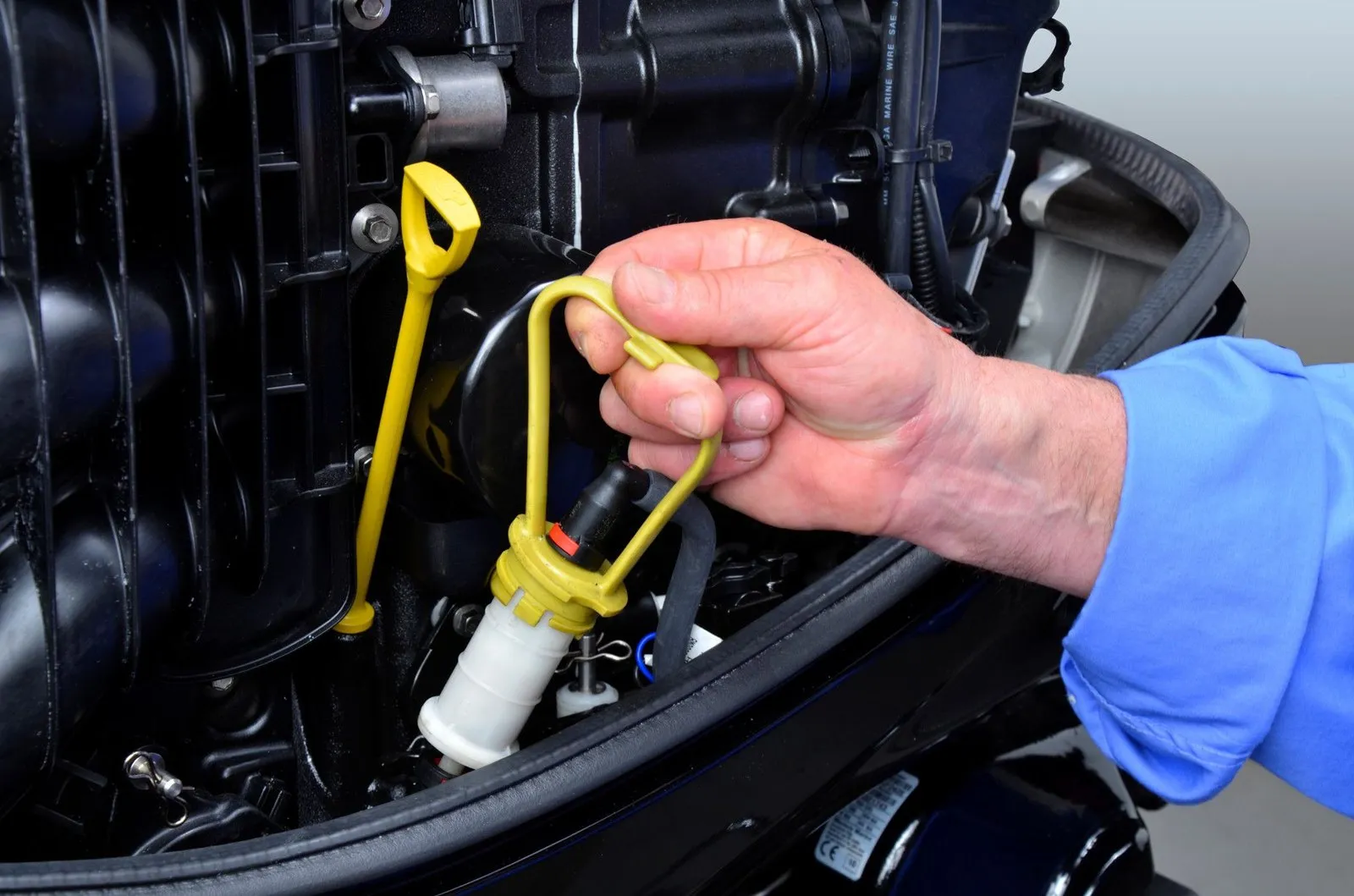
The white cartridge in the photo is the engine fuel filter on a Mercury 150 FourStroke. It’s one of the parts we check before pricing a replacement fuel module. Photo courtesy of Mercury Marine.
Short answer
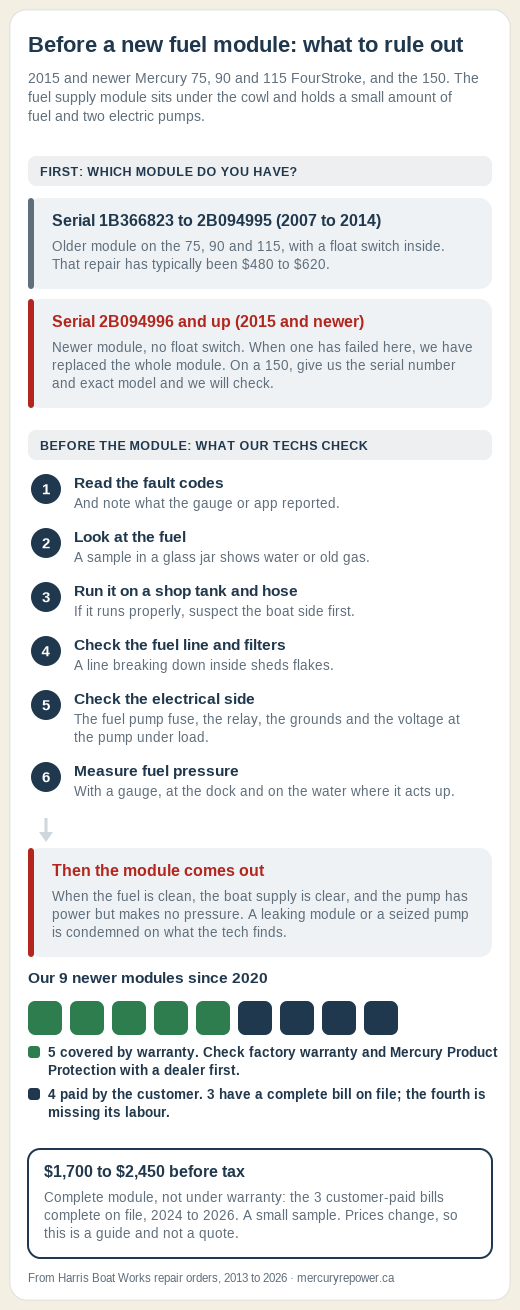
On a 2015 or newer Mercury 75, 90 or 115 FourStroke (serial 2B094996 and up) and the 150, the fuel supply module has no float switch in it, and when one has failed here we have replaced the whole module. We have done nine since 2020. Five were covered by warranty, and the three customer-paid jobs with a complete bill came to $1,700 to $2,450 before tax. That is a small sample. Check warranty first, and rule out the cheaper causes before anyone orders one.
What the fuel supply module does
The module sits under the cowl and holds a small amount of fuel. Inside it are two electric pumps, a low-pressure one that keeps it supplied and a high-pressure one that feeds the injectors, plus a pressure regulator, all in one plastic housing.
On the 2007 to 2014 75, 90 and 115 there is also a float switch that tells the lift pump when to run, and that small part is what usually fails. The newer module does not have one, so that cheaper repair does not exist for it.
Which module do you have?
Go by the serial number on the transom bracket, not only the model year. Our guide to reading a Mercury serial number shows where to find it.
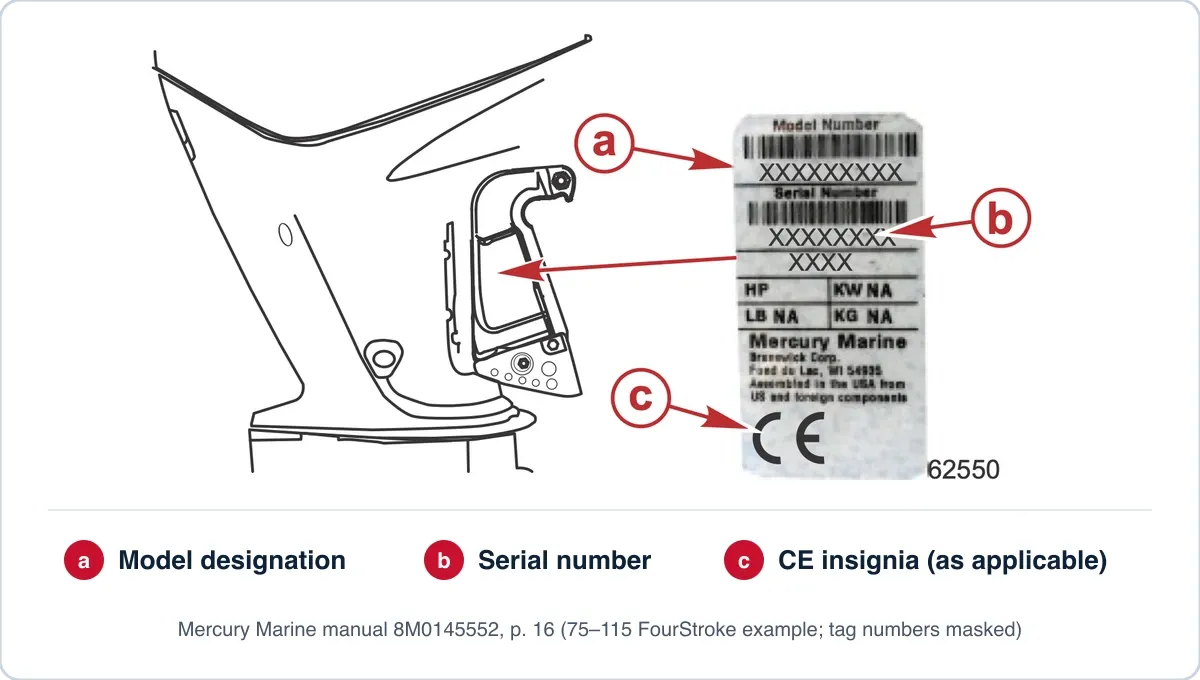
Use the bracket label to look up the right module. On this 2.1 L FourStroke, (a) is the model and (b) is the serial number. Mercury Marine 75–115 FourStroke owner’s manual 8M0145552, p. 16, fig. 62550.
75, 90 or 115, serial 1B366823 to 2B094995. The 2007 to 2014 module, with a float switch. If yours runs well for 15 to 30 minutes and then bogs, read our post on the 75, 90 or 115 that quits after 20 minutes. That repair has typically been $480 to $620.
75, 90 or 115, serial 2B094996 and up. The newer module this page is about.
150 FourStroke. The 150s we replaced modules on had the newer design. One of our 58 float switch jobs was on a 150 Verado, which uses the older switch. On any 150, give us the serial number and exact model and we will check.
What it looked like on our nine jobs
Nine complete modules since 2020, on eight motors; one motor needed two. Where the work order recorded the horsepower, they were 90, 115 and 150 hp motors, and every one came in between June and October.
- Started, ran a few seconds, then quit. Six seconds on one, about thirty on the other. 2 jobs.
- Would not start at all. On one, the tech measured and found no fuel pressure. 2 jobs.
- Quit while running along. The fuse for the fuel pump had blown, and once the module was out the pump inside had seized. 1 job.
- Fuel on the water. When the key was turned on, fuel came out of the telltale, and the tech found the module leaking through. Mercury's technical line told us to replace it. 1 job.
- Warning horn above about 3,500 RPM, with a fuel pump fault on the gauge display. 1 job.
- Lost power again after earlier fuel trouble. 2 jobs.
Most were a motor getting no fuel, or losing it suddenly, unlike the slow fade after twenty minutes on the older motors.
How we confirm it before replacing the most expensive part
The module is the most expensive part here, so it comes last. Our techs work through the same order as in our guide to a Mercury that bogs down under load, and on these motors the steps before the module are:
- Read the fault codes and note what the gauge or app reported.
- Look at the fuel. A sample in a glass jar shows water or old gas.
- Run the motor on a shop tank and hose. If it runs properly, suspect the boat side first, though a module fault that comes and goes is not ruled out.
- Check the fuel line and filters. A line breaking down inside sheds flakes the motor has to pass through.
- Check the electrical side. The fuel pump fuse, the relay, the grounds and the voltage at the pump connector under load.
- Measure fuel pressure, at the dock and on the water where the motor acts up. That is a shop test with a gauge.
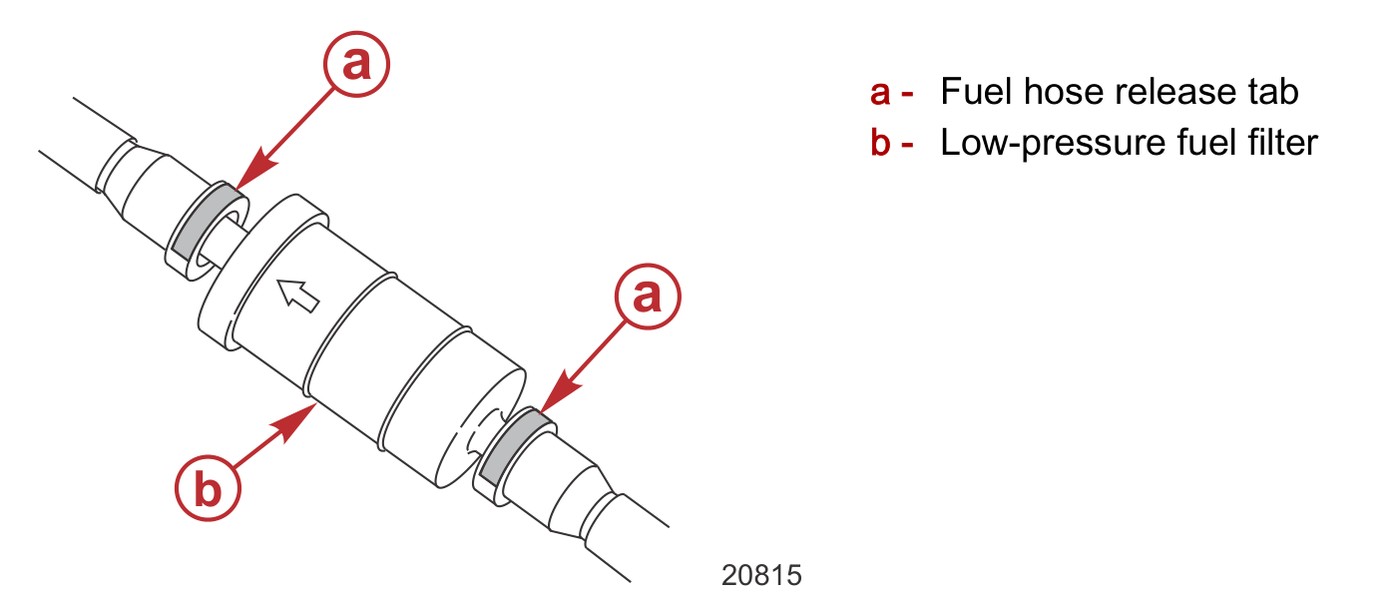
This is the low-pressure fuel filter (b) on a 2.1 L 75–115 FourStroke. It’s one of the things the shop checks before recommending a module. Mercury Marine owner’s manual 8M0145552, p. 58, fig. 20815.
On a motor that is not getting fuel, the module comes out once we know the fuel is clean, the boat supply is clear, and the pump has power but makes no pressure. A module leaking fuel or a seized pump is condemned on what the tech finds.
A fuel pump fault code does not settle it by itself. In 2024 a 2016 150 came in because it quit, with a fuel pump fault stored. The tech found air in the fuel system and primed it, and the pressure came up right. These motors prime themselves and should not have a primer bulb, so that was shop work. No module, and the bill was about $125.
Warranty and Mercury Product Protection come first
Five of our nine were covered by warranty. Where the work order recorded the year, those were 2019 to 2023 motors. The customer-paid ones included two 2017 90s.
Before you pay for a module, find out whether the motor is still under factory warranty or Mercury Product Protection, Mercury's extended coverage. A Mercury dealer can check from the serial number. If you bought the boat used, unexpired coverage may transfer, so confirm with a dealer.
What it costs
These are the totals our customers paid, parts and labour, before tax, on jobs from 2024 to 2026.
Complete module replaced, not under warranty: $1,700 to $2,450 across the three bills we have complete. A fourth customer-paid job does not have its full labour on file, so it is not counted.
The two bills that were mostly the module came to about $1,730 and $1,840. The $2,450 job was a used boat being checked over for a trade, and the same bill covered draining the tank, a vent repair, a thermostat and a water pump impeller.
The module itself is most of the bill. Its price has gone up every year we have bought one. The swap has been about two hours of labour on our jobs.
If we find nothing wrong: you pay for the time spent looking, which on fuel complaints since 2024 has been about $125 to $210.
Prices change, so treat these as a guide and not a quote.
Find out why it failed
Replacing the module does not fix bad fuel or a boat-side line that is coming apart.
On one of our customer-paid jobs the fuel line from the boat was breaking down on the inside and pieces had reached the high-pressure filter. We replaced the line along with the module. The same boat came back a year later, and a second module went on after the tech traced the tank vent and found a charcoal canister soaked through with fuel and shedding dust. That story is in our post on black dust in a boat fuel filter. The other 2017 90 had water in its fuel twice in earlier years before its module failed.
We cannot say those caused the failures. They are good reasons to look at the fuel and the boat's fuel line and tank vent whenever a module is replaced.
If it happens on the water
- If you smell fuel or see a sheen, shut the motor off and do not restart it. Fuel should never be coming out of the motor.
- If the warning horn sounds, throttle back to idle and check the gauge or app. A horn can mean overheating or low oil pressure as well as a fuel fault. If no cause shows, or the telltale stream is weak, shut down.
- If it quits and will not restart, stop cranking. Anchor if you are drifting somewhere you should not be, and call for a tow.
What not to do
Do not order a float switch for a motor with a serial number of 2B094996 or higher. There is no float switch in it.
Do not buy a module before the pressure has been measured and the power to the pump checked. Rule out the fuse, the connections and the fuel first.
Do not keep replacing a fuel pump fuse that blows, and never fit a bigger one. On the one job where we found that fuse blown, the pump had seized.
Do not open a fuel-injection line to check for fuel. Those lines hold pressure. Leave that to a shop.
What to tell us when you book
The serial number from the transom bracket, what the motor does and when, whether the horn sounds or a fault shows on the gauge, whether you see or smell fuel, and whether the motor is still under warranty or Mercury Product Protection.
We are Harris Boat Works, on Rice Lake in Gores Landing, Ontario. Service requests are at hbwservice.ca.
The counts on this page are from our own repair orders, December 2013 to November 2026.
Sources
- Mercury Marine Canada: Limited Warranty and Product Protection Transfer, accessed November 25, 2026. Confirm serial-specific coverage with a dealer.
- Mercury Marine Service Bulletin 2014-01, new model information for the 2.1 L 75 to 115 FourStroke (dealer bulletin).
- HBW service records review, November 2026: technician notes on 959 fuel-system repair jobs, December 2013 to November 2026, classified by what was found and fixed. Costs are from 2024 to 2026 jobs, parts and labour before tax (no customer data used)
About the author
Jay Harris runs Harris Boat Works, a family marina and Mercury dealer on Rice Lake in Gores Landing, Ontario. The repair counts and costs on this page come from the shop's own work orders.