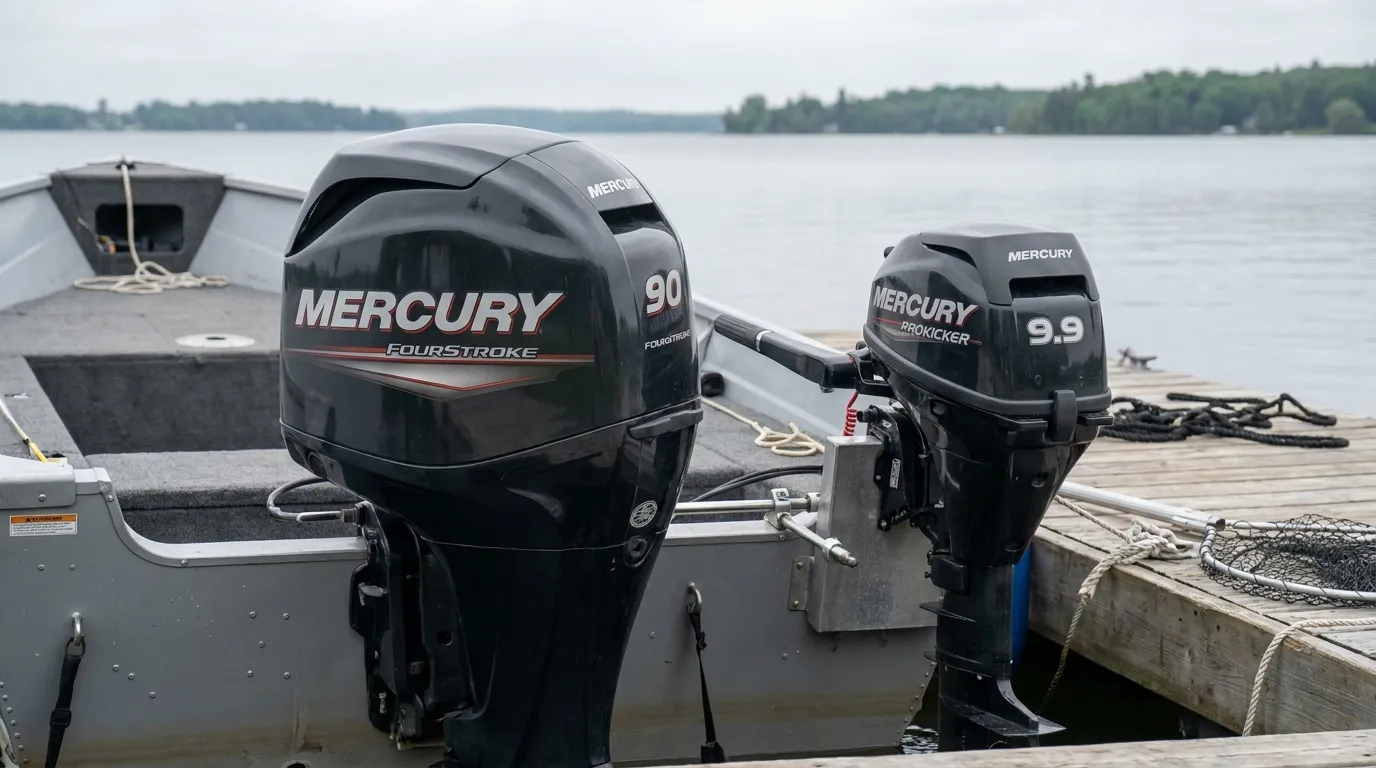
Most repower customers come in asking about the main motor. Serious fishing customers think about the pairing. Because the main motor and the actual fishing job are not the same task. This post walks through what we rig at HBW for Rice Lake and Kawartha anglers. ## Why pair a...
Quick answer: Pairing a Mercury main outboard with a kicker or bow electric trolling motor can add low-speed fishing control and backup propulsion. A 9.9 HP ProKicker is a common gasoline option; an Avator may suit quiet, low-speed use when the boat, mounting, route, and battery reserve fit. The package must be quoted against the actual boat because mounting, steering, fuel or charging, wiring, transom capacity, and waterline all matter. Pickup is at Gores Landing.
Most repower customers come in asking about the main motor. Serious fishing customers think about the pairing. Because the main motor and the actual fishing job are not the same task. This post walks through what we rig at HBW for Rice Lake and Kawartha anglers.
Why pair a main motor with a second fishing drive system?
Your main outboard is there to carry the boat, crew, fuel, and gear between spots. At trolling speed it can use more fuel and add more prop wash than a properly sized kicker or bow electric. Long low-speed use also adds hours to the main powerhead, so the right second drive can be a better fit for the fishing job.
A second drive system solves all three problems. It idles efficiently, runs quietly, and trolls cleanly. You travel on the main, switch to the kicker or electric when you arrive, and fish for hours on a fraction of the fuel, while keeping unnecessary hours off the big powerhead. Redundancy is the second benefit: if the main fails 10 miles from the dock, the kicker gets you home slowly but reliably.
What are the kicker and trolling motor options for a Mercury main?
Three options most Rice Lake customers consider.
| Option |
Power |
Fuel |
Noise |
Endurance |
Current price |
Best for |
| Mercury 9.9 HP ProKicker |
9.9 HP gas |
Gasoline |
Quiet idle, audible |
Unlimited with fuel |
See the Mercury pricing reference |
Most fishing boats, all-day trolling, big water |
| Mercury 6 HP FourStroke |
6 HP gas |
Gasoline |
Quiet idle |
Unlimited with fuel |
See the Mercury pricing reference |
Smaller boats |
| Mercury Avator 7.5e electric |
0.75 kW prop-shaft output |
1 kWh battery |
Near-silent |
Depends on boat, load, route, weather and throttle |
See the Avator page for current availability |
Compatible boats needing quiet low-speed operation |
The 9.9 ProKicker is the most common choice. It has enough power to push an 18 to 20 foot fishing boat at trolling speed in chop, works as emergency get-home power, and idles smoothly. It runs on the same gasoline as the main motor and can share the tank through a dual-output water separator.
The Avator 7.5e is worth considering when silence matters and the boat, load and route fit its 0.75 kW prop-shaft output and battery range. It is not a gasoline-horsepower substitute on paper; compare the actual speed, range, charging and reserve requirements for your boat. Our Avator 7.5e review goes deeper on the electric option.
When should you choose a bow electric trolling motor instead?
A bow-mounted electric trolling motor is a different category from a kicker. It is a small electric motor (commonly 12V, 24V or 36V, depending on thrust) mounted on the bow of the boat, controlled by foot pedal or wireless remote with GPS spot-lock features. It is not a get-home backup. It is a fishing tool for spot-locking, casting drift, and shallow-water finesse.
Choose the bow electric first when your fishing is about boat position more than travel endurance. Bass, panfish, shallow-water walleye drifting, and weed-edge work all lean this way. The ability to move quietly, hold a line on a drop-off, and keep your hands free changes the day.
A kicker makes more sense when the day gets longer and the water gets bigger. If you troll open water for hours, if you want a real backup engine, or if the boat already carries a big main motor, a kicker starts to make more sense quickly. Many serious bass and walleye anglers run both: a Mercury main, a Mercury kicker for trolling longer distances, and a bow-mounted electric for casting and spot-locking. It is belt-and-suspenders fishing rigging.
We do not sell bow-mounted electric trolling motors directly (Mercury does not make one in that category), but we can rig the wiring, mount the bracket, and integrate the system during your repower. Many customers pick up a bow-mount from a tackle shop and bring it to us for installation alongside the main motor.
How does the kicker mount, steer, and wire to the boat?
The kicker mounts on a separate bracket bolted through the transom alongside the main motor. The bracket gets the kicker far enough from the main that both motors can swing on their tilts and turn freely. Three rigging considerations matter most.
First, the bracket itself. The bracket must be rated for the kicker and matched to the transom, waterline, shaft length, and required clearance. Some brackets are height-adjustable, which matters when the transom is non-standard. HBW quotes the current bracket and installation against the boat.
Second, steering. If you want the kicker to steer with the main so you can turn from the helm, you need a compatible tie-bar or steering linkage. The exact hardware and labour depend on the two motors, spacing, and steering system.
Third, fuel and electrical. A gasoline kicker may share the boat's fuel supply through a correctly sized water-separating filter and boat-specific routing, or use a separate approved tank. Electric start and charging need a reviewed battery and switching plan. An Avator needs a charging plan instead of a gasoline supply. HBW prices those items only after reviewing the boat.
What main + kicker pairings work best on Rice Lake?
A main-and-kicker package adds both total transom weight and an offset load to one side. Whether that works depends on the exact motor variants, bracket, battery location, hull, transom rating, and static waterline. We verify those details before rigging any second motor; an electric option is not automatically the lighter installed system once its battery and mounting are included.
A few combinations we rig regularly at Harris Boat Works for Rice Lake and Kawartha fishing customers:
- 16 to 17 ft aluminum: Mercury 60 HP main + Mercury 9.9 ProKicker. Fast enough to cross the lake, quiet enough to fish for walleye.
- 17 to 18 ft aluminum or fibreglass: Mercury 90 HP main + Mercury 9.9 ProKicker. The most popular fishing setup we sell.
- 18 to 19 ft deep-V aluminum: Mercury 115 HP main + 9.9 ProKicker; an electric alternative requires a boat, route, mounting and battery-range review.
- 20 ft fibreglass bass boat: Mercury Pro XS 175 to 200 main + bow-mounted electric (third party) + optional 9.9 kicker.
- Fishing pontoon: size the gasoline main to the capacity plate and load; any electric kicker requires a displacement, mounting, route and battery-range review.
Package totals depend on the main motor, the kicker, and the rigging your boat needs. Start with the current main-motor price in the quote builder, then ask HBW to quote the kicker and boat-specific rigging as one combined package. Our Mercury repower cost guide breaks main motor pricing down by HP class, and our 9.9 ProKicker on Rice Lake guide goes deeper on the most common kicker we install.
What we see at HBW
Three patterns from rigging fishing boats every spring on Rice Lake.
The 9.9 ProKicker on a 17-foot aluminum with a 90 HP main is the most common fishing rig we sell. It is the boat that works for walleye trolling, perch fishing, family days, and the occasional bass run. If you are not sure where to start, that is a defensible default.
The biggest fishing-rig mistake is skipping the tie-bar linkage. Customers who skip it usually come back the next season to have it installed. Reaching back to the kicker tiller while running the main from the helm gets old fast.
An electric kicker can make sense when quiet low-speed operation matters. The decision depends on the boat, displacement, mounting, route, required range, charging plan and battery reserve; HBW confirms those details before recommending an Avator.
Ready to rig your fishing boat?
Start with the main motor at mercuryrepower.ca, then request a combined main-and-kicker quote for your boat. We are the repower side of the Harris Boat Works service team on Rice Lake. The quote, rigging and water test stay with the same shop.
Phone: 905-342-2153
Address: 5369 Harris Boat Works Rd, Gores Landing, ON
Service: hbwservice.ca
Family-owned since 1947, Mercury dealer since 1965, Mercury Premier Dealer.