Quick answer Before you launch your Mercury outboard for the first time after winter storage, work through this pre-season checklist. Some checks happen before the engine runs; others happen at the dock or under load. Check the battery voltage and connections, inspect the...
Quick answer
Before you launch your Mercury outboard for the first time after winter storage, work through this pre-season checklist. Some checks happen before the engine runs; others happen at the dock or under load. Check the battery voltage and connections, inspect the fuel for separation or stale fuel, look for damaged or dry-rotted fuel lines, confirm the propeller is tight and undamaged, and check the lower unit oil for water contamination. At the dock, follow the exact engine manual for cooling-water supply, starting, and cooling-flow checks. If anything looks wrong, do not run the motor under load. These checks can help identify problems before launch.
Why spring run-up matters in Ontario
A Mercury outboard that sits from October to May goes through five months of cold, fuel breakdown, condensation, and pest activity. Most boats come out of storage just fine. The ones that don't usually fail in one of three ways: they won't start, they overheat within 5 minutes, or they run rough and stall. Investigate the cause before running the motor under load.
Every April and May, our service shop sees spring run-up problems that a short structured check before launch would likely have caught. The checklist below covers the patterns we see most often.
The checklist
Before you leave home
1. Battery voltage and terminals. With the motor off and disconnected from any chargers for at least an hour, measure the battery voltage with a multimeter. You want to see 12.4-12.7 volts on a healthy fully-charged battery. Below 12.2 volts means the battery is undercharged or failing. Cracked, swollen, or leaking batteries should not go into the boat: they should go to a recycler.
Clean the battery terminals if there's any white powder or corrosion, tighten the terminal bolts, and confirm the battery is secured in its tray. A battery that slides around in chop is a battery that loses contact at the worst time.
For more on battery selection and care, our Mercury Boat Battery Guide covers the full conversation.
2. Fuel inspection. Open the fuel tank and look at the fuel. Fresh gasoline looks pale yellow and smells like gasoline. Old fuel looks darker, often with a varnish smell. Phase-separated ethanol-blend fuel looks cloudy or has visible water at the bottom. If any of those describe your fuel, drain it before launching. We see ethanol-related fuel issues every spring and they account for a meaningful share of our spring "won't run right" calls.
3. Fuel lines. Visually inspect the fuel line from tank to motor. Look for cracking, dry rot, kinks, or rodent damage. Mice can chew through a fuel line in a single weekend if the boat sat unmonitored. Replace any line that looks suspect: $20-$40 in parts versus a $4,000 powerhead repair after fuel-air mixture damage.
4. Propeller condition. Spin the prop by hand (motor off, in neutral). It should spin freely but with some resistance from the gearcase. Look for dents, chunks taken out of blade edges, or fishing line wrapped around the shaft. Confirm the prop nut is secure and its tab washer or retainer is bent into place. When reinstalling, torque it to the figure in your manual: for example, 75 Nm (55 lb-ft) on the 150 FourStroke.
At the launch ramp
5. Trim and tilt operation. With the motor down, press the trim button up and down through the full range. The motor should pivot smoothly and quietly. Grinding, hesitation, or no movement at all means the trim hydraulic system needs attention.
6. Lower unit oil check. This is the one most owners skip. Remove the upper vent plug to check that gear oil is at the hole, or crack the lower fill/drain plug to check the oil's colour. On Mercury gearcases, the lower plug is the fill/drain plug and the upper one is the vent. Healthy gear oil is dark green or brown and smooth. Milky white or chocolate-milk colored oil means water has gotten in, which means the seal needs replacing before you run the motor. Skipping this check and running a motor with water-contaminated gear oil is how you turn a $200 seal job into a $2,000 gearcase rebuild.
Starting the motor
7. Prime the fuel system. Squeeze the primer bulb until it's firm. This pushes fuel from the tank to the motor and confirms the line is clear.
8. First start. With the motor down in the water (always, never run a Mercury outboard out of water without a flush attachment), key on, choke or fast-idle as needed for cold starts, and crank.
A healthy motor should start within 3-5 seconds of cranking. If it cranks but won't start, stop after 10 seconds, wait 60 seconds, and try again. Repeatedly cranking a flooded motor can drain the battery and overheat the starter.
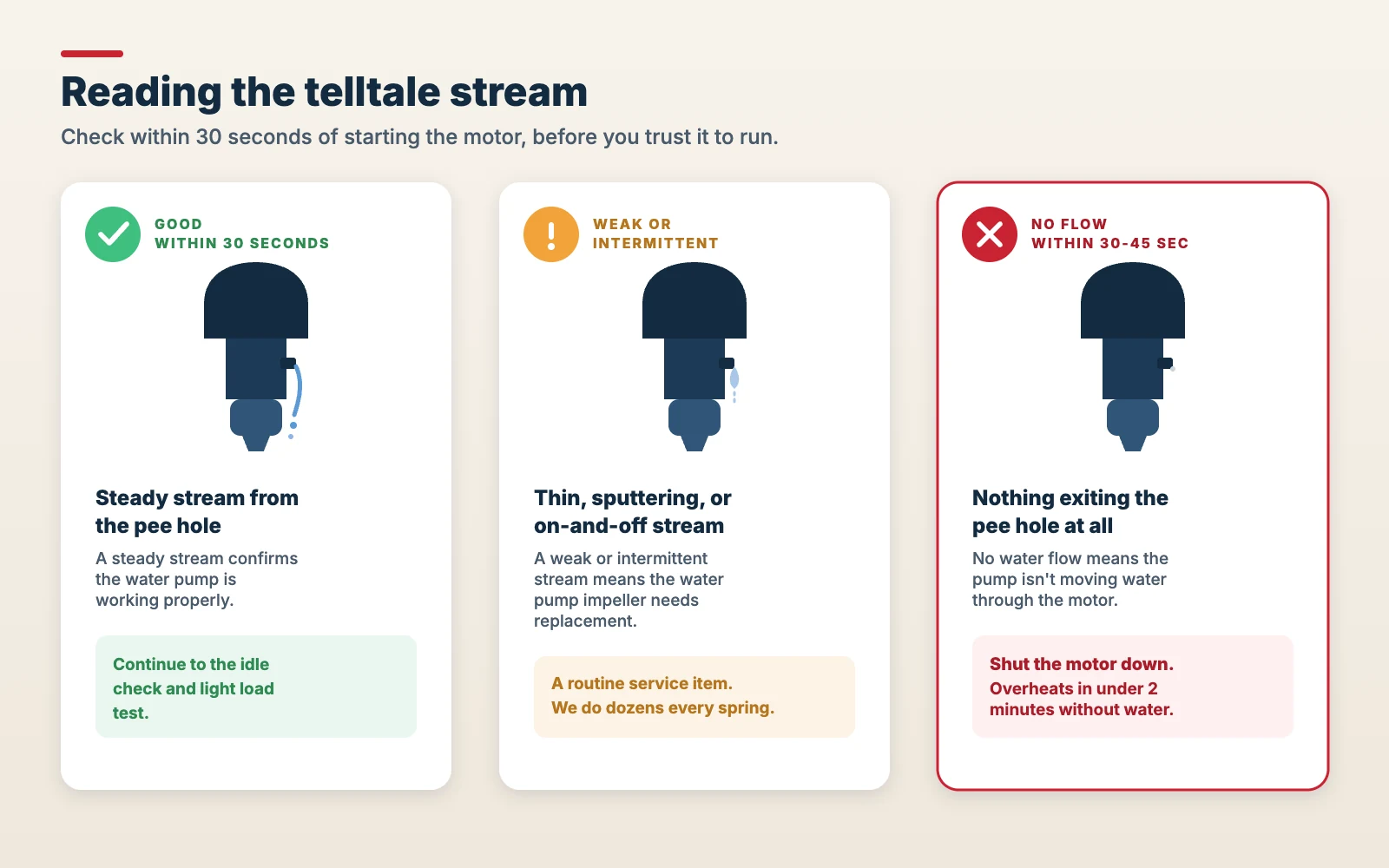
9. Telltale water stream. Within 30 seconds of the motor starting, you should see a steady stream of water exiting the small "pee hole" on the side of the motor. This stream confirms the water pump is working. If you don't see water flow within 30-45 seconds, shut the motor down. Running without water flow will overheat the motor in under 2 minutes and cause expensive damage.
A weak or intermittent water stream means the water pump impeller needs replacement, which is a routine $200-$400 service item we do dozens of times every spring.
Prices here are planning figures as of October 2026. For live Mercury motor pricing, see the Mercury pricing reference.
10. Idle check. Let the motor idle for 2-3 minutes at the dock. Listen for unusual sounds (knocking, hissing, irregular firing) and watch for smoke beyond the normal first-start exhaust. Brief blue or white smoke at first start is normal as oil burns off. Continuous heavy smoke means something is wrong.
11. Test under light load. Idle out from the dock at no-wake speed. Run for 2-3 minutes at idle to confirm everything is steady. Then bump up to 2,500-3,000 RPM for another 2-3 minutes. Watch the gauges (if you have SmartCraft, watch RPM, fuel flow, water temp). Listen for new sounds.
12. Test under full load. Once you've confirmed everything looks normal at low and medium RPM, run the boat through the full RPM range. Trim through the range. The motor should accelerate cleanly to its target WOT (wide-open throttle) RPM.
If anything feels wrong during this sequence, stop. Don't push through. Most spring problems get worse, not better, when ignored.
When something is wrong, the most likely culprits
Won't start at all: dead battery, bad ground, flooded engine, or a fuel system issue. In that order, check those four.
Starts but won't stay running: stale fuel, clogged carb or fuel injector (EFI covers the larger FourStrokes, while the small portable models can still be carbureted), or a fuel filter that needs replacing.
Starts but runs rough: ethanol-related fuel issue, weak spark from old plugs, or a vacuum leak somewhere in the air intake.
Starts but no water flow: impeller failure. Stop the motor. Do not run. We've seen impellers go from "fine in November" to "failed in May" sitting through one winter, because the rubber vanes can take a set and stiffen after months without running.
Overheats within 5 minutes: impeller, blocked water intake (mud, weeds, mouse nest), or a stuck thermostat. Same rule: stop the motor.
Our Mercury Outboard Won't Start Troubleshooting Guide and Mercury Overheating Guide cover these in more detail if you want to dig deeper.
What we see at HBW
The single most common spring issue we diagnose is a weak or dead battery. Fuel-related problems, including stale fuel, ethanol separation or damaged fuel lines, and impeller failures are also frequent. Together, those patterns make up a large share of the spring calls we receive, and each starts with a short owner-side check.
For full spring commissioning service where we do the run-up plus a full inspection, our intake is at hbwservice.ca.
For engine repairs, we only service Mercury and MerCruiser.
Sources
- Mercury Marine seasonal maintenance procedures (dealer technical reference, 2026)
- Transport Canada Pleasure Craft Safety Guide
- HBW spring service intake records, 2020-2026
About the author
Reviewed by the Harris Boat Works service team. HBW handles Mercury and MerCruiser service from Gores Landing on Rice Lake. For engine repairs, we only service Mercury and MerCruiser. About Harris Boat Works.
