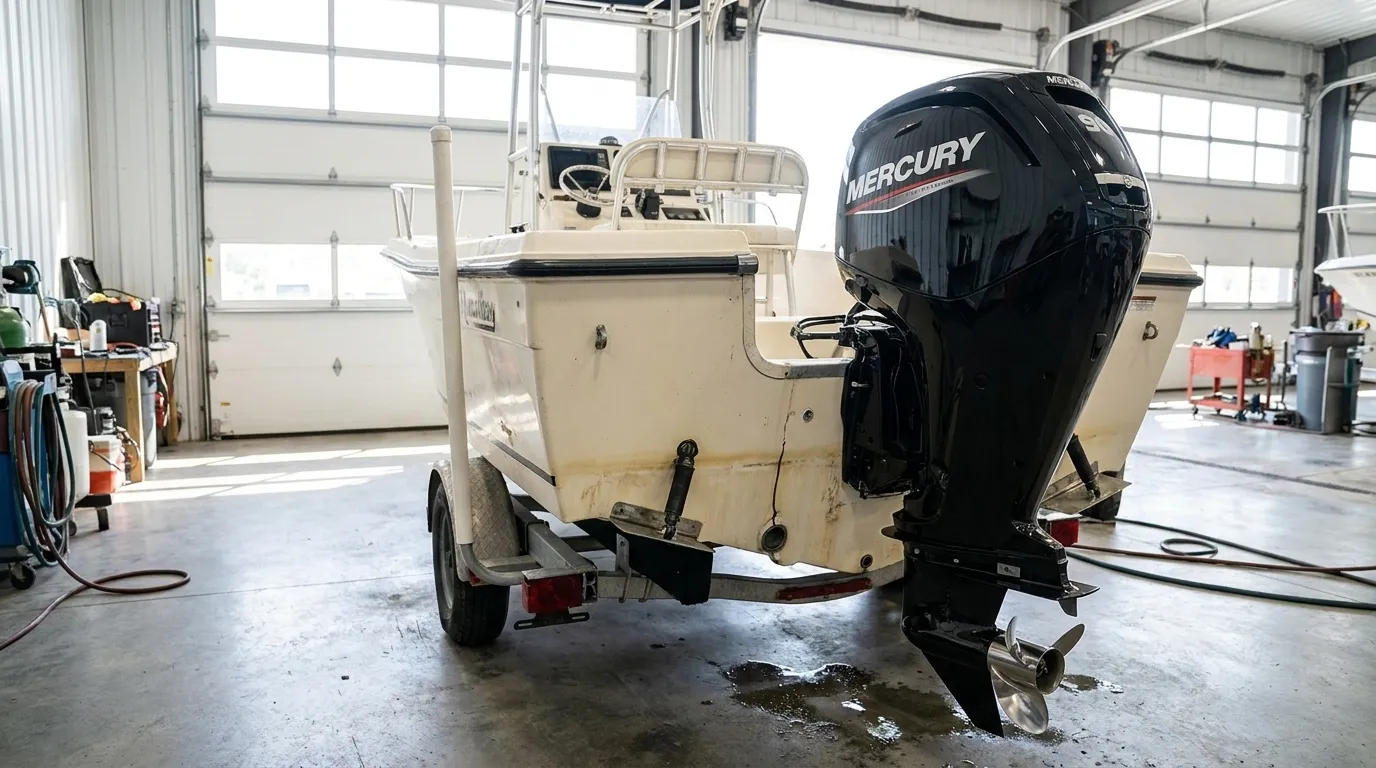
Your old 2-stroke still starts. That is exactly what makes this a hard call. It fires on the second pull, it gets the boat on plane, and a new FourStroke is real money out of pocket. So the honest question is not whether a 4-stroke is better. Everyone knows it is. The...
Quick answer: Mercury no longer lists 2-stroke outboards in its Canadian lineup, so a 2-stroke repower today means a modern Mercury FourStroke. You can gain quieter running, a cleaner idle, and better cruise efficiency. Weight and performance differences depend on the exact old and new models, so transom capacity, trim, propeller, and rigging need a boat-specific review. Installed cost depends on the motor, controls, rigging, and what we find on your boat, so start from the live Mercury pricing reference and quote builder at mercuryrepower.ca.
Your old 2-stroke still starts. That is exactly what makes this a hard call. It fires on the second pull, it gets the boat on plane, and a new FourStroke is real money out of pocket. So the honest question is not whether a 4-stroke is better. Everyone knows it is. The question is what changes on your boat the day you make the swap, and whether the math fits the way you actually use the water.
We have pulled tired 2-strokes off Rice Lake transoms for decades. Some of those repowers were overdue. A few should have waited a season. Here is the straight version: what gets better, what gets worse, and what it costs in Canadian dollars.
What is the difference between a 2-stroke and 4-stroke outboard?
A 2-stroke fires the spark plug on every turn of the crankshaft. Power on every stroke. That makes it light, simple, and strong for its weight. The price of that simplicity is that it burns oil right along with the fuel, so it runs louder, dirtier, and thirstier.
A 4-stroke fires every second turn. It keeps its oil separate, in a sump or oil-injected, so it burns clean, idles smooth, and sips fuel by comparison. The trade is weight and a few more moving parts: valves, a camshaft, a timing chain.
For a repower today, Mercury has already settled most of the debate. The OptiMax had its run, but the current lineup is FourStroke, Pro XS, SeaPro and Verado, all four-stroke, plus the electric Avator. Repower now and you are going FourStroke. The real decisions are downstream: weight, rigging, and prop.
How does a FourStroke compare to the 2-stroke I am replacing?
Here is a modern 90 HP FourStroke against the 90 HP 2-stroke most Ontario customers are pulling off.
| Spec |
Older 90 HP 2-stroke |
Mercury 90 HP FourStroke |
| Dry weight |
~140 to 145 kg |
~163 kg (about 359 lb) |
| Idle |
Lopey, rough |
Smooth, quiet |
| Fuel burn at cruise |
Compare measured use on the same hull |
Compare measured use on the same hull |
| Oil |
Pre-mix or VRO injection |
Sump or oil injection |
| Noise at idle |
Loud |
Notably quieter |
| Emissions |
High, smoky |
Virtually none |
| Cold start |
Cranky |
Reliable |
| Top speed (same hull) |
Reference |
Within 1 to 2 mph |
| Hole shot |
Slightly quicker |
Slightly slower, more low-end torque |
| Maintenance |
Annual service plus plugs |
Annual service, longer intervals |
Three wins land the first morning you run it: the idle, the fuel gauge, and the quiet. The one real compromise is weight, and that is the next section, because it is the part people skip.
Does the weight difference cause any problems?
It can, and the boats that get this wrong are the ones where nobody asked the question. The difference varies by the exact old and new models, shaft length, gearcase, and rigging. In one representative comparison, a vintage 90 HP 2-stroke near 141 kg (310 lb) and a modern 90 HP FourStroke near 163 kg (359 lb) differ by about 22 kg (49 lb). The effect on static trim and the splash well depends on the hull, so we compare the published weights and inspect the transom before selecting the replacement.
Three things we check before any 2-stroke to 4-stroke repower:
Transom first. A boat 25 years and up can hide soft, wet core behind a skin that still looks fine. A heavier motor on a punky transom is a problem you do not want to meet on the water. We sound every transom before we install. If it needs repair, you hear it straight. If it is past saving, we say that too, even when the honest answer is a different boat.
Waterline second. A heavier motor drops the stern at rest. We check it against the scuppers and splash well so the new engine does not change how the boat sheds water.
Prop third. A FourStroke makes its torque differently than the 2-stroke did, so the prop that was right before is often wrong now. We re-prop most repowers and water-test on Rice Lake until the engine hits its rated RPM band wide open.
What rigging changes when you repower from 2-stroke to 4-stroke?
You cannot unbolt the old motor, hang the new one, and plug it into the same dashboard. The wiring, the throttle cables, the gauge protocols: all of it moved on. Most 2-stroke repowers roll in with mechanical controls two decades old, and a new motor deserves better than a worn shift box.
What we usually check or replace includes the control box and cables, fuel line and primer bulb, battery cables, steering, gauges, and propeller. Digital controls or gauges may be part of the scope when the selected motor supports or requires them. The written quote identifies each retained and replacement component. Our what happens during a Mercury repower guide walks the full sequence, removal to water test.
How much does it cost to repower a 2-stroke to a Mercury 4-stroke?
We do not publish a static installed price table, because it goes stale faster than motor pricing moves. Installed totals vary with the exact motor, controls, steering, rigging, propeller, removal, and boat-specific findings. Use the live Mercury pricing reference and quote builder for a current starting point, then rely on the written installed scope. HBW's standard repower handoff includes an on-water test on Rice Lake before pickup when safe seasonal conditions allow; any alternate acceptance plan is documented with the customer. Pickup only at Gores Landing. HBW does not ship motors or deliver.
HBW evaluates Mercury 2-stroke trade-ins and other brands case by case. Submit the serial number, hours, condition, and photos through the trade-in value page. Financing is available on approved credit. The full breakdown by motor class lives in our Mercury repower cost guide.
When should you repower instead of repairing the old 2-stroke again?
Three signals, usually. The repair quote crosses the line where you are paying to own the past instead of the future. The boat is still worth keeping even though the motor is not. Or the way you use the water has outgrown the engine: more people aboard, longer runs, fishing that wants a quieter ride.
Solid hull, boat still fits your life? Repower. You keep the boat you trust and replace the wear part. Tired hull, questionable transom, a layout that no longer matches your weekends? Then the honest conversation is about the boat, not just the motor. Either way, winter is the planning window. The marina is closed December 1 to April 1, so no service or install work happens in those months, but that is exactly when to have the conversation and hold a spot. The 2026 season opened April 6. Book before the spring calendar fills, because it does.
What we see at HBW
The happiest repower customers walked in expecting the trade, not just the upgrade. They wanted the quiet idle and the smaller fuel bill, and they already knew the transom would carry a little more weight. The repowers that disappoint are the ones where somebody skipped the transom check or never touched the prop, and a great motor ends up feeling wrong on a boat it should have transformed. That is why the transom inspection and the Rice Lake water test are not add-ons here. They are the job. The same crew that quotes your repower is the crew that rigs it and runs it off our dock.
Ready to plan your 2-stroke repower?
If your 2-stroke is on borrowed time, the winter planning window is where to start. Build a FourStroke repower quote at mercuryrepower.ca.
Phone: 905-342-2153
Configurator: mercuryrepower.ca
Service: Harris Boat Works, a family marina in Gores Landing serving boaters since 1947
Phone: 905-342-2153
Address: 5369 Harris Boat Works Rd, Gores Landing, ON
Configurator: mercuryrepower.ca
Harris Boat Works, family-owned since 1947. A Mercury Premier Dealer, selling Mercury since 1965.