The most avoidable service bills don't usually begin with a dramatic failure. They begin with a small change that gets dismissed: a warning that clears after a restart, a new vibration, a starter that turns more slowly, or an engine that no longer reaches its usual speed....
Quick answer: Don't treat a new warning, cooling-flow change, vibration, slow crank or power loss as something to “run through.” Reduce load, move to a safe place, follow the serial-number owner's manual and record exactly what happened. The first fault may be limited. Continued operation can add heat, impact, low voltage or contaminated fuel to the repair.
The most avoidable service bills don't usually begin with a dramatic failure. They begin with a small change that gets dismissed: a warning that clears after a restart, a new vibration, a starter that turns more slowly, or an engine that no longer reaches its usual speed.
This isn't a diagnosis chart. Several systems can produce similar symptoms, and generic beep-code advice can be dangerously wrong. It's a symptom-to-action guide: what to notice, how to protect people and equipment, and what information helps a technician find the cause.
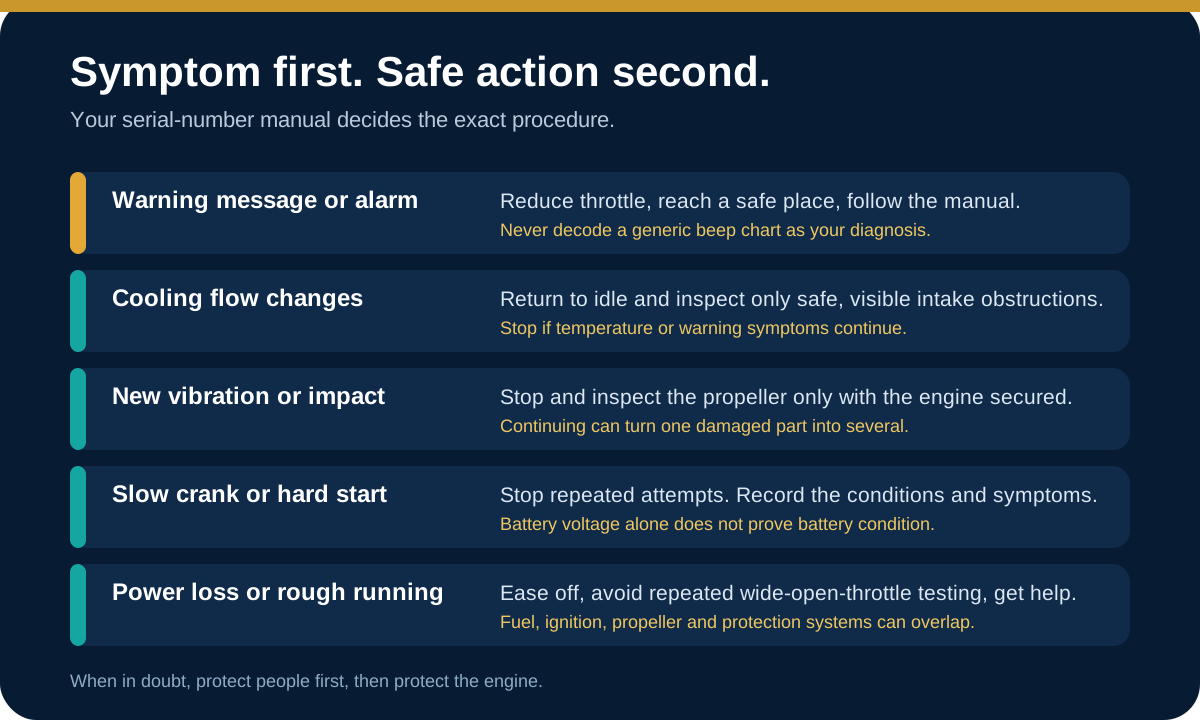
1. Continuing After a Warning
A SmartCraft message, Guardian response or audible warning is the engine asking for attention. The meaning and permitted response depend on the model, control system and exact message.
Reduce throttle, make the boat safe and consult the owner's manual for that engine serial number. If the warning remains, operating quality changes or the manual directs shutdown, stop the engine. Do not repeatedly restart it to see whether the alarm “goes away.”
Record:
- the exact words, icons or gauge readings
- engine speed and boat speed when it appeared
- whether power was automatically limited
- water and weather conditions
- what changed immediately before the warning
A video of the stationary display can help. Filming while operating the boat cannot.
2. Ignoring a Cooling-Flow Change
The telltale is useful, but it is not a complete cooling-system health gauge. Its appearance can vary by model and conditions, and a visible stream does not cancel a temperature warning.
If flow changes or a temperature warning appears, return to idle and reach a safe location. With the engine off and secured, look only for safe, visible issues such as weeds or debris at the water intakes. Follow the manual before doing anything more.
Do not push back to full throttle as a test. Cooling complaints can involve intake blockage, pump condition, thermostat operation, passages, sensors or other causes that cannot be separated from the helm.
3. Running Through a New Vibration or Propeller Impact
A new vibration after hitting bottom, a floating object or heavy weeds is a reason to stop. A propeller can look only slightly damaged while producing imbalance, and fishing line can collect behind the propeller where it may affect seals.
Secure the engine against starting before any propeller inspection. Follow the manual for removal and installation, including hardware order and torque. Mercury recommends inspecting the propeller for damage and removing it several times during the season to check for fishing line.
Do not keep making wide-open-throttle runs to “see if it clears.” Vibration can affect more than the propeller, and an impact can involve the hub, shaft, gearcase or mounting system.
4. Treating a Slow Crank as a Minor Battery Problem
A battery can show voltage and still fail under load. Loose or corroded terminals, damaged cables, poor grounds, charging problems and an aging battery can all reduce cranking performance.
If the starter turns unusually slowly, stop repeated attempts. Check that connections are secure and free of corrosion as the owner's manual describes. A fully charged battery should be load-tested when its condition is in doubt. Use the battery type and rating specified for the exact engine.
Repeated low-voltage starting attempts can confuse the symptom picture and create heat at a poor connection. Replacing the battery from a resting-voltage reading alone is not a complete diagnosis.
5. Repeating High-Load Tests When the Engine Loses Power
Bogging, hesitation or failure to reach the usual operating range can involve fuel quality, delivery, ignition, propeller load, engine protection or rigging. The fact that it happens at higher throttle does not prove one cause.
Ease off and note the fuel source, approximate fuel age, tank selection, engine speed, load and conditions. Current Mercury gasoline engines permit fuel containing no more than 10 percent ethanol. E15 and E85 are not approved. If contamination or incorrect fuel is plausible, do not keep drawing it through the system.
Avoid opening pressurized fuel components or improvising an on-water fuel transfer. Safe diagnosis may require pressure, electrical and scan-tool tests.
Symptom-to-Action Table
| What changed |
Safe immediate response |
What to document |
What not to assume |
| Warning or Guardian response |
Reduce load, get safe, follow exact manual |
Message, icon, RPM, conditions |
A generic beep pattern identifies the fault |
| Cooling-flow change |
Idle, reach safety, inspect only visible intakes |
Warning, stream change, weeds, water depth |
A visible telltale proves normal temperature |
| New vibration or impact |
Stop and secure engine |
Impact, speed, propeller condition |
A small nick is only cosmetic |
| Slow crank or hard start |
Stop repeated attempts |
Battery age, connection state, sound |
Resting voltage proves battery health |
| Rough running or power loss |
Ease off and arrange diagnosis |
Fuel source, age, RPM, load |
Premium fuel or a new filter will cure it |
What to Send With a Service Request
Good intake information gets us to a sound diagnosis faster. Include:
- Engine serial number and model, not just horsepower.
- Engine hours if available.
- Exact symptom and the first date it appeared.
- The operating conditions when it happens.
- Any warning text, icons or Guardian response.
- Recent fuel, battery, propeller or maintenance changes.
- Clear photos or stationary video that can be captured safely.
- What you have already checked or replaced.
Avoid a shopping list of parts based on forum guesses. “Replace the fuel pump” gives a technician less useful information than “loses power above 3,800 rpm with either tank after refuelling Tuesday.”
What We See at HBW
The useful pattern is not that every warning has one favourite cause. It is that the best intake notes preserve the clues: exact message, RPM, fuel source, battery history, what changed, and when it started.
Around Rice Lake and the Kawarthas, getting those details before the boat reaches Gores Landing can save a lot of backtracking. A clear symptom history helps us test the right system first instead of replacing parts on a guess.
Maintenance Helps, but Symptoms Outrank the Calendar
Mercury commonly organizes routine maintenance around engine-hour and annual intervals, with additional items at longer intervals. The exact schedule comes from the serial-number owner's manual.
That schedule is a minimum plan for a normally operating engine. It does not mean a new warning or performance change should wait until the next annual service. Likewise, a recently serviced engine is not immune from impact, contaminated fuel, a loose connection or a new fault.
Useful owner checks include:
- correct engine oil and level procedure
- battery terminals and specified battery condition
- propeller and fishing-line inspection
- fuel filters at the exact manual interval
- cooling-water intakes clear of visible debris
- control, steering and mounting hardware checks
The work becomes model-specific quickly. That is why the serial number belongs in every service request.
Common Diagnosis Mistakes
Reading a universal alarm table. Warning logic differs across engines and control systems. Use the exact manual and displayed message.
Changing several parts at once. It erases evidence and may introduce a second problem without proving what fixed the first.
Testing under maximum load. A repeated full-throttle run can turn a warning into damage.
Assuming new fuel is good fuel. Octane, ethanol content, contamination and storage history are separate questions.
Calling every slow crank a dead battery. The battery, cables, terminals, grounds, starter and charging system need to be considered together.
Get the Cause, Not a Guess
We diagnose Mercury outboards using the engine identity, symptom history and appropriate tests before recommending a repair. We'd rather find the cause than sell you a guess.
Start a Mercury service request
Sources
