Quick answer Most Ontario center console buyers are running trailerable 18 to 25 ft hulls on Lake Ontario, the Bay of Quinte, or occasionally Georgian Bay.
Quick answer
Most Ontario center console buyers are running trailerable 18 to 25 ft hulls on Lake Ontario, the Bay of Quinte, or occasionally Georgian Bay. The right Mercury motor is often a 200 to 250 HP Pro XS for fishing-focused single-engine setups, or a 250 to 300 HP motor for larger or premium twin configurations. Those 200 to 250 Pro XS ratings are current V8 models, not V6. Confirm the exact family before treating horsepower as architecture. The Florida offshore assumptions built into most center console guides do not apply here. Build a quote at mercuryrepower.ca.
Honest rigging pick
Single or twin Mercurys on a center console?
Most 22 to 25 ft center consoles run great on a single. Twins are about redundancy, not speed.
Choose single engine if
- ✓Center console is 22 to 25 ft
- ✓Most runs are coastal cruising, family use, dock-and-dine
- ✓Fuel economy and quiet operation matter
- ✓You want single-engine simplicity (one motor to maintain)
- ✓The boat is rated for a single-engine setup
Single Mercury 250 or 300 HP
Choose twin engines if
- ✓Center console is 25 ft or larger and runs offshore
- ✓Redundancy matters (limp-home capability if one fails)
- ✓You want maximum performance for chasing fish or rough water
- ✓Twin-engine handling at the dock is a feature, not a problem
- ✓The boat was designed for twins from the factory
Twin Mercury V8 outboards
When in doubt:A single Pro XS V8, sized one Mercury model below the capacity-plate maximum, handles most 22 to 25 ft center consoles beautifully. Twins are only worth it if you fish offshore or want the safety net of redundancy.
Why this guide is different
Most center console buying guides are written for a Florida audience: 26-foot offshore hulls, triple motors, blue-water fishing trips. That is not Ontario. The center console buyer who shows up at Harris Boat Works is typically running a trailerable 20 to 24 foot hull on Lake Ontario for salmon, the Bay of Quinte for walleye, or occasionally running Georgian Bay day trips. Different boats, different conditions, different priorities.
This guide is built around the Ontario reality.
The Ontario center console market: what actually moves
Ontario center console buyers are overwhelmingly trailerable. The boats that come through our shop look like this:
| Length |
Typical HP |
Common uses |
| 17 to 19 ft |
90 to 150 HP |
Bay of Quinte walleye, sheltered Lake Ontario, river running |
| 20 to 22 ft |
150 to 250 HP |
Lake Ontario salmon, Bay of Quinte, full-day trips |
| 23 to 25 ft |
200 to 350 HP (single or twin) |
Lake Ontario salmon runs, bigger-water Bay of Quinte |
| 25 to 28 ft |
250 to 400 HP (twin) |
Premium Lake Ontario / Great Lakes setup |
| 28+ ft |
Triple or quad |
Rare in Ontario, mostly U.S.-import boats |
The 20 to 24 foot trailerable class is where most of the real buying decisions happen. Whatever the hull, the best fit is usually one Mercury model below the capacity-plate maximum, so check the plate before choosing a motor.
Mercury motor families: which one for a center console?
FourStroke (90 to 150 HP)
Mercury's 90 to 150 HP FourStroke models fit the small end of center consoles: 17 to 20 feet, lighter hulls, moderate use. These motors are quieter and smoother than Pro XS at the cost of slightly less hole-shot and top speed.
Best for: 17 to 20 ft hulls, mixed fishing and recreation, customers who prioritize smoothness and fuel economy over peak performance.
Pro XS (115 to 300 HP)
The Pro XS line is Mercury's performance-optimized outboard. Current families do not share one architecture: 115 and 150 are inline-four, 175 is V6, and 200, 225, 250, and 300 are V8. Purpose-built for fishing use: optimized hole-shot, aggressive mid-range power, and competitive top-end speed.
For Ontario center consoles, Pro XS is the default recommendation for fishing-focused buyers.
- 200 Pro XS 4.6 L V8: Common starting point for 20 to 22 ft hulls
- 250 Pro XS 4.6 L V8: Step up for larger 22 to 25 ft hulls or heavier loads
- 300 Pro XS 4.6 L V8: Performance upgrade for 23 to 25 ft hulls, tournament application
Best for: Fishing-focused center consoles, 20 to 25 ft hulls, buyers who want aggressive performance and do not need quiet cruise.
Verado (250 to 600 HP)
Mercury's premium outboard. Quieter, smoother, and more refined than Pro XS at comparable HP. The current Mercury Verado lineup runs from 250 to 600 HP across V8, V10, and V12 configurations. Verado is special-order at HBW, so check our live pricing reference before planning availability.
For most Ontario fishing-focused center consoles, Verado is more motor than the job requires and adds significant cost. It earns its cost mainly on twin-engine setups, where the ride quality and noise difference actually matters across multiple hours at cruise.
Best for: Premium builds, twin-engine setups, buyers prioritizing ride quality and quiet operation.
Recommended motor by boat size
17 to 19 ft trailerable
Motor: Mercury 90 to 115 FourStroke, or 115 Pro XS if you want more hole-shot.
Performance: 35 to 42 mph two-up.
Use case: Bay of Quinte walleye, sheltered Lake Ontario days, river running.
20 to 22 ft trailerable
Motor: Mercury 200 Pro XS 4.6 L V8 is a common starting point. 150 Pro XS (3.0 L inline-four) works on the lighter 20 ft hulls.
Performance: 45 to 55 mph two-up with the 200 V8, depending on hull, load, and prop.
Use case: Lake Ontario salmon, Bay of Quinte, full-day trips.
This is the most common Ontario center console application.
23 to 25 ft single engine
Motor: Mercury 250 Pro XS V8 (4.6L) for fishing; Verado V8 (special order) if quiet ride at cruise matters more than hole-shot.
Performance: 50 to 60 mph two-up.
Use case: Lake Ontario salmon tournament days, bigger-water Bay of Quinte.
25 to 28 ft twin-engine
Motor: Twin 250 Pro XS V8 for performance; twin Verado V8 (special order) for premium ride.
Performance: 55 to 65 mph two-up.
Use case: Offshore Lake Ontario, premium fishing or family use.
If you are buying a 25 to 28 ft center console in Ontario and you plan to run it in October salmon season, twin engines are not a luxury.
28+ ft (rare in Ontario)
Motor: Triple or quad Mercury Verado V10 (special order) for peak performance.
Use case: Top-tier Great Lakes setups; most of these boats are U.S. imports.
Single vs twin: how to actually decide
1. What the hull is rated for. Most boats are designed for one configuration. Do not fight the manufacturer's bracket rating.
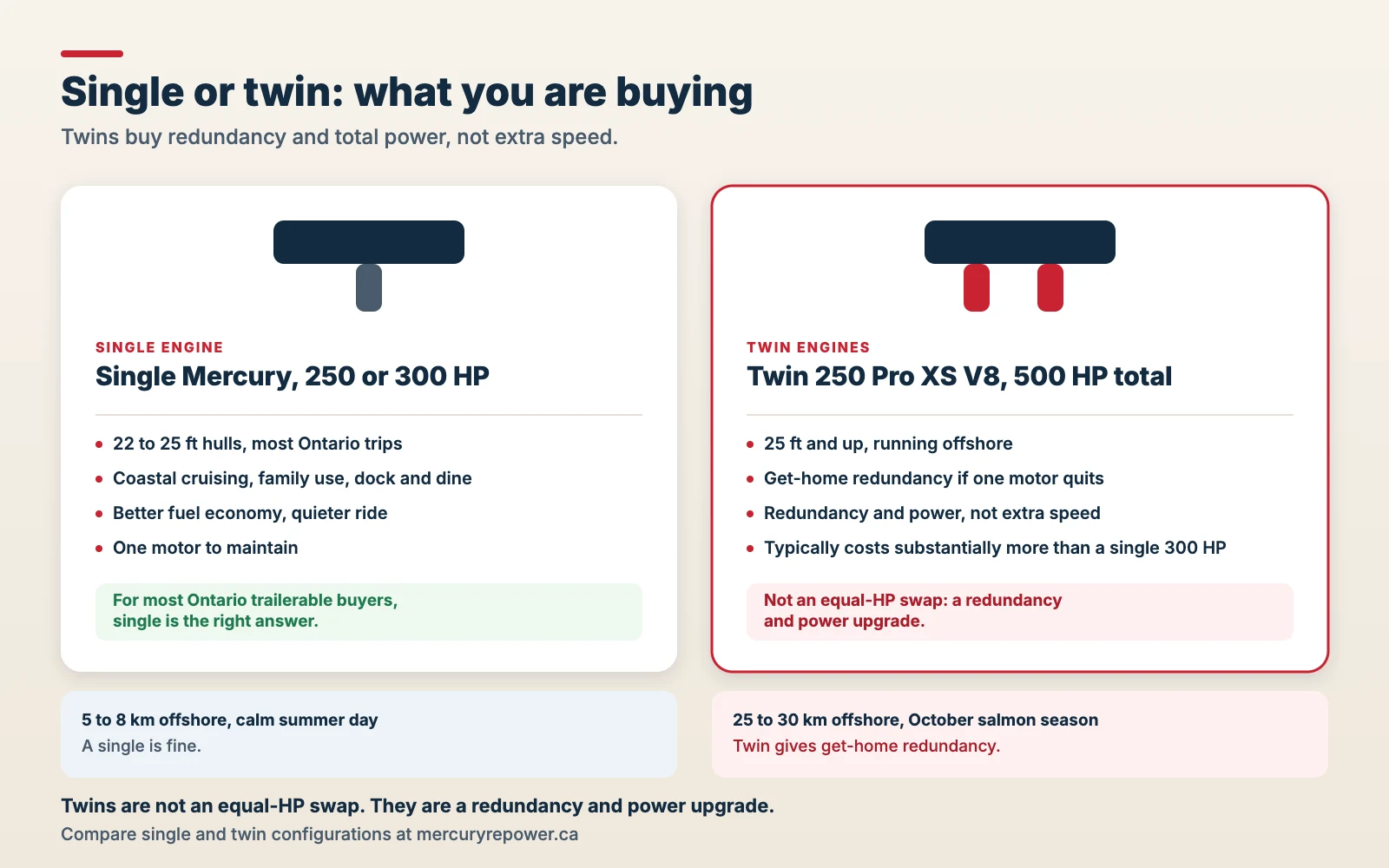
2. How far offshore you run in worst-case conditions. If your longest trip is 5 to 8 km offshore on Lake Ontario on a calm summer day, a single is fine. If you are running 25 to 30 km offshore in October targeting salmon, a twin gives you get-home redundancy when one motor quits far from shore.
3. Whether you want Mercury Joystick Piloting. If docking precision matters to you, Joystick Piloting is a real quality-of-life upgrade. The conventional outboard package uses two or more DTS-equipped engines. Mercury also offers package-specific single-engine systems, but most single-engine rigs do not qualify. The available package has to be confirmed against the exact engine, steering, controls, and hull.
The cost difference is real. A twin-Mercury 250 Pro XS V8 setup gives you 500 total HP and typically costs substantially more than a single 300 Pro XS V8; compare both configurations at mercuryrepower.ca. Twins are not an equivalent-horsepower alternative; they are a redundancy and power upgrade. For most Ontario trailerable buyers, single is the right answer.
Mercury Joystick Piloting: what it actually does
Conventional Joystick Piloting controls thrust direction across multiple motors, letting you walk the boat sideways into a slip at low speed without using the wheel. In practice, it is genuinely useful for:
- Tight marina slips with crosswind
- Docking single-handed
- Trent-Severn locks where you are holding position against current
Conventional multi-engine package requirements:
- Twin or more matched Mercury outboards (same family, same HP, same generation where possible)
- Electronic shift and throttle (no mechanical cable)
- DTS-compatible Mercury motors; confirm the exact engines and package before planning around joystick
Single-engine joystick is a narrow, package-specific exception, not a general feature of single-engine Mercury rigs. Mercury's Joystick Piloting for Single-Engine Outboards with Thruster requires an electric-steering Verado or SeaPro V8, V10, or V12 outboard from 250 to 600 HP plus a compatible CAN-based variable-speed thruster. Mercury also lists Joystick Steering for Single-Engine Vessels as a separate system. Most single-engine center consoles do not qualify, so confirm the complete package before treating joystick as part of the repower plan.
Cost: Varies with motor generation and existing controls; build the full package at mercuryrepower.ca for a current figure.
Rigging details that matter for center consoles
Prop selection: Aluminum props on a 200+ HP center console are a false economy. Mercury Bravo I FS or Fury 4 in the right pitch is a common starting point for these higher-HP families. Confirm hub, gearcase, and part number before ordering. Budget for a quality stainless prop on a fresh repower; current prop pricing is on our /pricing-reference page.
Hydraulic steering: Required on many of these higher-HP motors. SeaStar Pro hydraulic is our default. Confirm the exact engine and control option.
NMEA 2000 backbone for twins: If you are running twin motors, plan a proper NMEA 2000 backbone for chartplotter-engine integration and Joystick if applicable.
Transom bracket check: Modern center consoles use transom brackets that move the motor 12 to 30 inches aft of the transom. Verify bracket rating before we quote a motor size.
Spring commissioning: Boats stored with us are kept outdoors and shrink-wrapped as standard. Annual pre-launch service helps prevent a cooked impeller from ruining your first week of salmon season.
Why Ontario center console buyers come to us
We have been a Mercury dealer since 1965. Center-console repowers are a real part of our shop volume because we know the Ontario use case: Lake Ontario salmon, Bay of Quinte walleye, and the occasional Georgian Bay day trip.
We do not oversell Verado to fishing-focused buyers. Pro XS is the right motor for most Ontario fishing-focused center consoles. When the premium is actually justified by how the boat is being used, Verado is available by special order.
Pickup is at Gores Landing, and your motor was rigged by a tech who has put a lot of Lake Ontario and Bay of Quinte center consoles in the water.
