Quick Answer Mercury's cheapest current outboard in Canada is the 2.5 HP FourStroke portable. But the cheapest motor that genuinely fits your boat's use and HP rating is almost always the better question, and those are rarely the same motor. Live pricing at mercuryrepower.ca.
Quick Answer
Mercury's cheapest current outboard in Canada is the 2.5 HP FourStroke portable. But the cheapest motor that genuinely fits your boat's use and HP rating is almost always the better question, and those are rarely the same motor. Live pricing at mercuryrepower.ca.
Quick estimate: Try our Repower Cost Estimator for a CAD ballpark based on your boat size and current motor. Free, no email required.
Compare the same purchase scope
For a portable tiller motor, confirm the exact motor, shaft length, starting system, supplied accessories, preparation, and tax.
For an installed remote-control repower, also itemize compatible controls, steering, gauges, propeller, installation, and testing. The work required depends on the boat and existing equipment. Compare dated written quotes with the same inclusions; use the current pricing reference for motor prices.
Use current prices for your comparison. Open the motor pricing reference, then build a quote with the controls, propeller, rigging and installation your boat needs. Compare the same purchase scope rather than an old price chart.
Full Article
The honest answer most boaters need isn't "what's the cheapest motor" but "what's the cheapest motor that actually works for my boat." Those are usually different motors, and confusing them is one of the most common expensive mistakes we see.
We've watched too many Rice Lake customers buy the smallest motor they could afford, spend three seasons struggling to get on plane against the afternoon wind, then trade in for what they should have bought the first time. That's paying twice for the same boat-equipping job.
The Mercury Lineup at the Low End
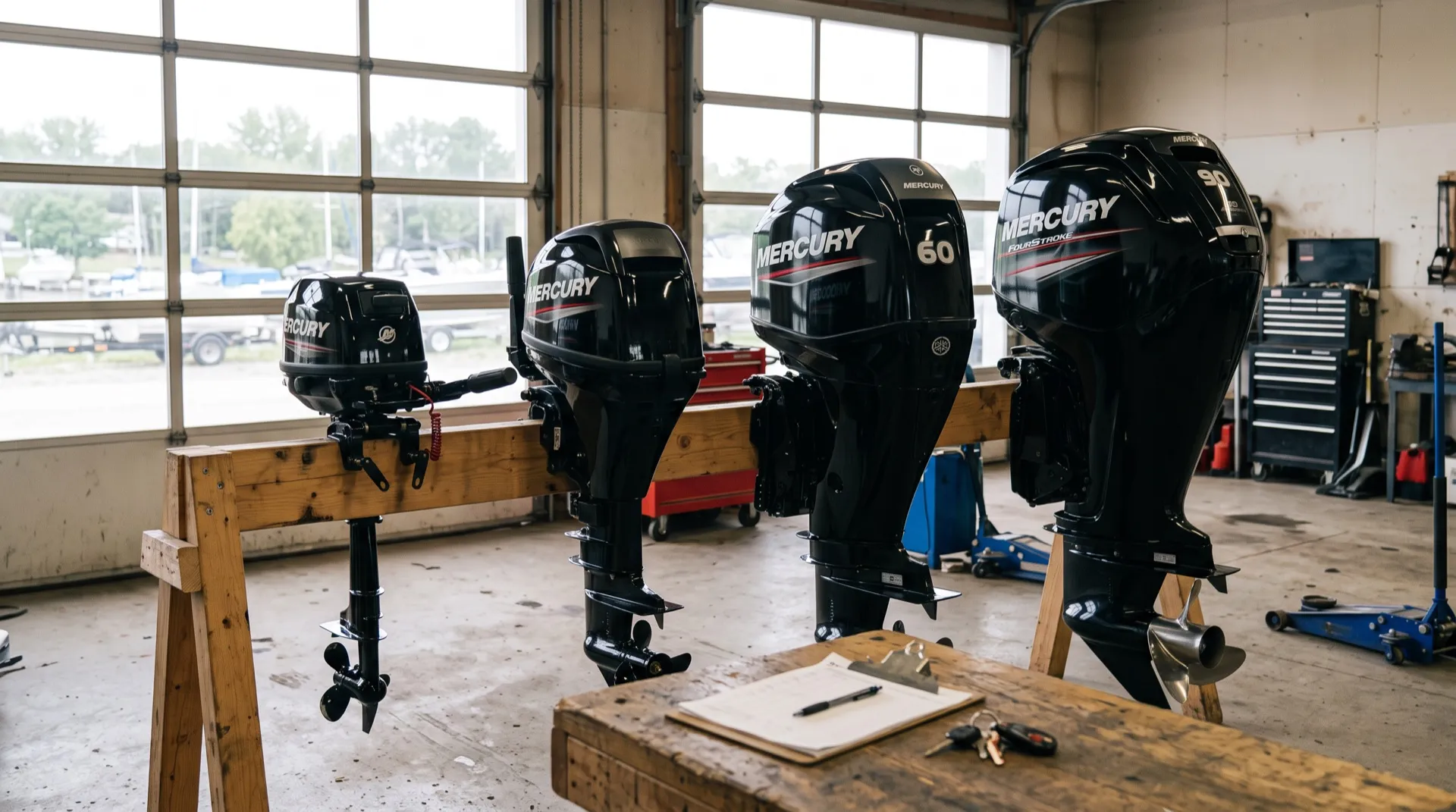
From smallest to largest, with what each class actually powers:
| HP Class |
Common Models |
What It Powers |
Install Type |
| 2.5-6 HP portable |
2.5 MH, 3.5 MH, 4 MH, 5 MH, 6 MH |
Tenders, dinghies, small inflatables, kicker |
Confirm exact model and mounting |
| 8-20 HP tiller |
8 EFI, 9.9 MH/EH/ProKicker, 15 MH, 20 MH |
Small aluminum (12-14 ft), kicker |
Confirm exact model and mounting |
| 25-60 HP |
25 EFI, 40 ELHPT, 50 ELHPT, 60 ELHPT |
14-16 ft aluminum, small consoles |
Confirm tiller or remote configuration |
| 90-115 HP |
90 EXLPT, 115 EXLPT FourStroke / Pro XS |
16-19 ft aluminum, fishing boats, small pontoons |
Full repower with rigging |
| 150-200 HP |
150 ELPT FourStroke, 175/200 Pro XS |
18-22 ft pontoons, runabouts |
Full repower with hydraulic steering |
For a tiller model, confirm the mounting, shaft length, fuel-system connections, starting system, supplied equipment, and preparation required for the exact boat.
Remote-control installations can require controls, cables, gauges, a propeller, and installation labour. Horsepower alone does not identify which work or equipment is included.
For current pricing on each model, use the live pricing reference or build a configured quote.
What Changes the "Cheapest That Works" Answer
Six things determine where your real floor is:
Boat size and weight. A 12-foot inflatable can be powered by a 2.5 portable. For a 16-foot aluminum boat, planing depends on the exact hull, load, propeller, motor setup, and operating conditions.
Use case. Fishing solo at trolling speed has totally different power requirements than cruising with two people or pulling a tube.
Where you launch. A pontoon at a sheltered private dock can run a smaller motor than the same pontoon at the Bewdley ramp on a windy Rice Lake afternoon. Check the forecast before heading out and plan for the load you carry.
Solo vs. family. Adding two adults and a cooler turns "marginal" power into "stranded."
Capacity plate. Overpowering a hull creates compliance, insurance, and warranty problems. The capacity plate sets your ceiling. We won't quote above it.
Long-term plan. A motor for one season is different math than a motor you're keeping for 15 years.
Cheap That Is Not Actually Cheap
Buying too small. A motor that does not suit the loaded boat can fall short of the intended performance. Check the hull rating, weight limits, and expected load before choosing.
Buying off-brand. A no-name motor is cheaper at the till. Then a part fails in year three, no Canadian dealer carries it, and the motor becomes scrap. Mercury parts and service are available across Canada because Mercury has been the dominant outboard brand here for decades. That network has real value.
Buying used without inspection. A used motor is a great way to save money. A used motor purchased blind is a great way to spend $3,000 and end up with a paperweight. We inspect every used motor we sell. We'll inspect a private-sale motor for a fair fee before you buy it.
Skipping rigging on a remote-control install. Saving $2,000 by reusing 22-year-old controls isn't savings if the throttle sticks at full speed on Rice Lake. Mercury-to-Mercury repowers can often keep existing controls in good condition, that's part of what makes Mercury-to-Mercury the cheapest repower path.
Chase the Savings portable rebates
As of October 5, 2026, Chase the Savings runs September 14–October 30, 2026 and offers eligible Canadian portable buyers these CAD rebates: 2.5–3.5 HP: $250; 4–9.9 HP: $300; 15–20 HP: $350; 25–30 HP: $400. Available eligible new dealer stock must be sold and delivered during the window. Portable rebates are unavailable in Newfoundland and Labrador. Model, use, registration and other exclusions apply; confirm current promotions on the written quote. Qualifying Chase the Savings TD financing may be combined with cash or credit rebates, excluding Special Markets rebates.
Cheap That Is Actually Cheap
Buy in winter. The shop closes December 1 through April 1, but we quote and take orders all winter. Ask about exact-model availability and the installation schedule before planning a spring launch. Mercury sometimes runs promotional financing rates below the standard rate, check the promotions page on mercuryrepower.ca for current terms.
Trade in your old motor. Even a dead motor has aluminum and parts value. Trade-in credit reduces the amount you're financing or paying outright.
Mercury-to-Mercury repower. Existing controls and cables may be reusable if their compatibility and condition are confirmed. Compare the required work in written quotes.
Aluminum prop on smaller motors. On motors up to 115 HP, a standard aluminum prop works fine for most boaters and costs considerably less than stainless.
When the Cheapest Mercury IS the Right Answer
Real situations where the smallest Mercury is genuinely the perfect call:
- Tender or dinghy off a sailboat or cruiser. A 2.5-6 HP portable does the job and stows easily.
- Kicker on a fishing or pontoon boat. A 9.9 ProKicker is the standard answer for trolling speed control. No point in more HP than you need for slow fishing passes.
- Solo low-speed fishing on small, sheltered water. A 9.9-15 HP on a 12-14 ft aluminum on sheltered water is a perfectly legitimate setup.
When the Cheapest Mercury Is NOT the Right Answer
Heavy hull or fiberglass runabout. Needs real power to plane.
Family use with passengers and gear. Add 91-181 kg (200-400 lbs) of crew weight to whatever the dry boat needs.
Rough water. Lake Ontario, Lake Simcoe in the afternoon, Bay of Quinte. Wind builds and an underpowered motor can't punch back through.
Active water sports. Needs HP and torque, not minimum power.
Long runs across open water. A 9.9 will eventually get you there. It's just going to be a long day.
Prices reflect HBW's current 2026 Mercury dealer pricing. See our live Mercury pricing reference for the latest dealer and MSRP per model.
Ready to find the right motor for your boat? Build a quote at mercuryrepower.ca, every model from the 2.5 portable through the 300 V8, live CAD pricing, no "call for price."