Canonical URL: https://www.mercuryrepower.ca/blog/mercury-115-vs-150-hp-outboard-ontario --- ## Quick Answer For most 17, 19 ft hulls, the Mercury 115 FourStroke is the right call, lighter, cheaper, and fully capable for typical Ontario family use. The 150 earns its price on...
Canonical URL: https://www.mercuryrepower.ca/blog/mercury-115-vs-150-hp-outboard-ontario
Quick Answer
For most 17, 19 ft hulls, the Mercury 115 FourStroke is the right call, lighter, cheaper, and fully capable for typical Ontario family use. The 150 earns its price on 18, 22 ft hulls, active watersports, or any boat that loads heavy. Both sit inside the same service footprint. Stay inside your capacity plate. Compare installed pricing at mercuryrepower.ca.
Honest power pick
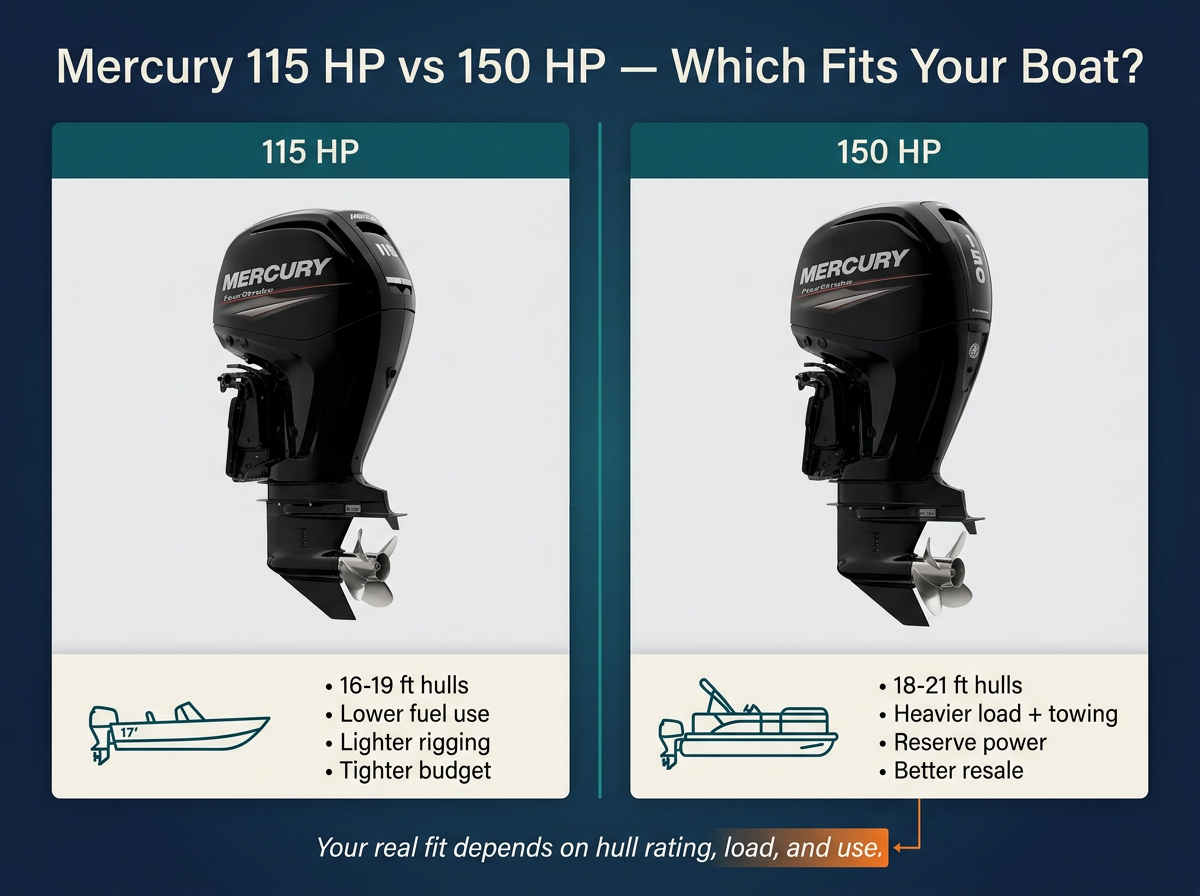
Should you choose Mercury 115 or 150 HP?
The decision usually comes down to boat length, what you tow, and your capacity plate.
Choose 115 HP if
- ✓Your boat is 17 to 19 ft and rated for 115
- ✓Most use is casual cruising, fishing, and light watersports
- ✓Hole shot and top speed are not your priority
- ✓You would rather spend the budget gap on accessories or storage
Pick 115 (FourStroke or Pro XS)
Choose 150 HP if
- ✓Your boat is 19 to 22 ft and the capacity plate allows 150
- ✓You tow tubes, wakeboarders, or skiers regularly
- ✓You want stronger hole shot with a full load of people and gear
- ✓You are repowering an older 150 and a like-for-like swap simplifies rigging
Pick 150 (FourStroke or Pro XS)
When in doubt:Check your boat's capacity plate first. If the rated max is 115, you cannot go higher. If rated 150 and the boat is over 19 ft, the extra power usually pays off the price difference within a season or two of resale value.
“Sales guy at a different dealer told me I needed 150 HP for my 19 ft Legend. Jay measured the transom, looked at the prop chart, and said 115 Command Thrust will do everything you want with better fuel economy. He was right. 38 mph loaded, sips fuel.
–Tom K.–HBW Customer, Lakefield 2026
Full Article
The step from 115 to 150 HP is bigger than the numbers suggest. The 115 FourStroke is a 2.1L inline 4-cylinder engine. The 150 FourStroke is a 3.0L inline 4-cylinder. More displacement, heavier motor, meaningfully more torque, especially at the hole shot. The price difference is roughly $4,000, $6,000 CAD all-in. For Mercury outboard prices from 2.5 to 300 HP, see our full reference.
Whether that difference is worth paying comes down to three questions: What hull are you putting it on? How do you use it? How do you load it?
When the 115 Is the Right Call
The Mercury 115 EXLPT FourStroke handles:
- 17, 19 ft aluminum console boats used for family fishing or mixed recreation
- 18, 20 ft pontoons used primarily for cruising and light fishing (no active water sports)
- Light fiberglass runabouts up to 19 ft
- Any boat rated to 115 HP maximum on the capacity plate
- Budget-conscious repowers where 115 HP genuinely fits the use case
The 115 is plenty motor for the most common Ontario use cases. The savings against the 150 (roughly $4,000, $6,000 CAD) can buy a kicker motor, better electronics, or a stainless prop, all of which move real-world performance on the existing motor more than the HP step-up does.
Most 115 EXLPT repowers at HBW land in the $17,000, $22,000 CAD range all-in, before HST.
When the 150 Earns Its Price
The Mercury 150 EXLPT FourStroke is the right call when:
- Hull is 18, 22 ft (aluminum, fiberglass, or pontoon)
- Active water sports are part of the use: tubing, skiing, wakeboarding, regularly, not just occasionally
- Loading is heavy (family of five plus gear, multiple coolers, heavy fishing tackle)
- Bigger water is the regular destination (Lake Ontario, Bay of Quinte, larger Trent-Severn lakes)
- You're doing serious morning runs to fishing spots and time matters
The 150's hole shot when loaded is meaningfully better than the 115. The difference in plane time matters when you're pulling skiers or running with a full crew. Mid-range cruising performance is significantly stronger.
Most 150 EXLPT repowers at HBW land in the $23,000, $36,000 CAD range all-in, before HST.
Side-by-Side: Mercury 115 vs. 150 FourStroke
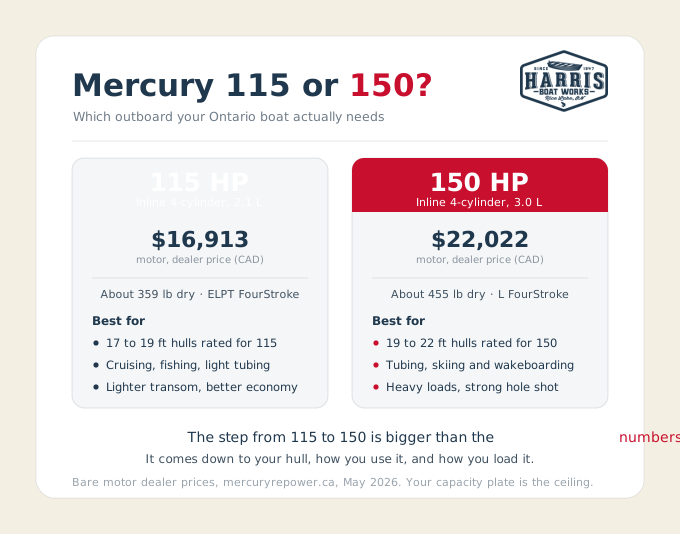
| Factor |
115 EXLPT FourStroke |
150 EXLPT FourStroke |
| Engine type |
Inline 4-cyl, 2.1L |
Inline 4-cyl, 3.0L |
| Weight (XL shaft) |
~163 kg / 359 lb |
~206 kg / 455 lb |
| Hole shot (loaded) |
Adequate |
Strong |
| Fuel economy at cruise |
Excellent |
Very good |
| Tow rating (typical hull) |
Light tubing, one to two skiers |
Two skiers, full tubing, wakeboarding |
| Best fit |
17, 19 ft aluminum, 18, 20 ft pontoons (cruising) |
18, 22 ft hulls, pontoons with water sports, loaded fishing |
| All-in price (CAD, before HST) |
$17,000, $22,000 |
$23,000, $36,000 |
What About the 150 Pro XS V6?
Mercury also makes a 150 Pro XS V6, a different engine architecture (V6 instead of inline 4) optimized for performance applications. This motor is the right call for tournament-level bass fishing where acceleration to morning spots matters, or performance hulls built for the V6's weight.
For typical recreational use, family fishing, cruising, casual water sports, the FourStroke 150 is the better value. The Pro XS V6 earns its premium on tournament applications.
The Mistakes We See Every Season
Buying 115 HP to save money on a hull that wants 150. A 22 ft pontoon at 115 HP feels underpowered when loaded. The customer trades up within a couple seasons at full price. Should have bought the 150 the first time.
Buying 150 HP when 115 was plenty. A 17 ft aluminum used for solo fishing at 150 HP is overkill. The motor outpowers the hull's typical use. The savings on the 115 are better spent on a kicker or electronics.
Picking on top speed alone. Most recreational use happens at cruise. Hole shot and load handling matter more than peak speed for typical Ontario boating.
You can build a live CAD quote for your repower online at Mercury Repower Centre.
Skipping Command Thrust on pontoons. Both the 115 and 150 have Command Thrust gearcase options. On pontoons, Command Thrust is usually the right call regardless of HP class, it moves performance on the hole shot meaningfully.
What we see at HBW
The 115 versus 150 question is the most-quoted comparison at our shop. Customers walk in expecting to save by going with the 115. By the time we add controls, props, and rigging, the spread is usually only $1,500-$2,500 installed. For a 19-foot pontoon or a 20-foot bowrider, the extra HP pays off in two-up cruising and tube-pulling.
The exception: aluminum tinnies under 17 feet. There the 115 is the better match. Lighter on the transom, easier on fuel, and matches the hull's design max.
Related at HBW
The full topic hub: Ontario Mercury Outboard Price Guide (2026): Real CAD Prices by HP Tier -- start here if you want the complete picture.
Two related guides in the same cluster:
FAQs
Is the Mercury 150 worth the extra money over the 115?
For 18, 22 ft hulls, water sports, or heavy loading: yes. For 17, 19 ft hulls used for family fishing without active water sports: the 115 is plenty, and the savings are well-spent on accessories.
What HP do I need for a 19, 20 ft pontoon?
For cruising and fishing without water sports, 115 HP Command Thrust is plenty. For active water sports or heavy family loading, 150 HP is the better fit.
Can I tube and ski with a Mercury 115?
Light tubing and one to two beginners, yes. Consistent wakeboarding with a full boat requires the 150 or higher. The 115 is marginal for active water sports with heavy loading.
What's the fuel economy difference between 115 and 150?
At cruise, the 115 is more efficient. The 150 is slightly less efficient but very good. At full load on a heavy hull, the 150 is sometimes more efficient than the 115 because it's working less hard.
Can I run a Mercury 150 on a boat rated up to 115 HP?
No. The capacity plate sets the legal and warranty-backed ceiling. Exceeding it creates compliance, insurance, and liability problems. We won't quote a motor above your capacity plate.
How long does a Mercury 150 last with proper maintenance?
Modern Mercury 150 FourStrokes properly maintained are typically good for 1,500, 2,000+ hours of running time. For a recreational boater, that often translates to well over a decade of useful life.
Will my 115 controls and rigging work with a 150?
Mercury-to-Mercury repowers from 115 to 150 often keep existing post-2010 controls. Heavier-gauge wiring and updated steering may be needed for the 150. We assess this during the hull walk-around.
Internal Links
About the author
Jay Harris helps run Harris Boat Works, a third-generation family marina in Gores Landing on Rice Lake, established in 1947. HBW is a Mercury Marine Platinum Dealer and Legend Boats dealer serving Rice Lake, the Kawarthas, and Ontario boaters who want straight answers before spending real money. Read Jay's full bio.
CTA
Ready to pick your motor? Build a quote for the 115 or 150 at mercuryrepower.ca, live CAD pricing, full configuration including rigging and prop.
Not sure which HP is right for your hull? Call 905-342-2153. We rig boats in this HP class every week and can give you the honest answer for your specific boat and use case.
Ready to price it out? Build a live CAD quote for your repower online at the Mercury Repower Centre.