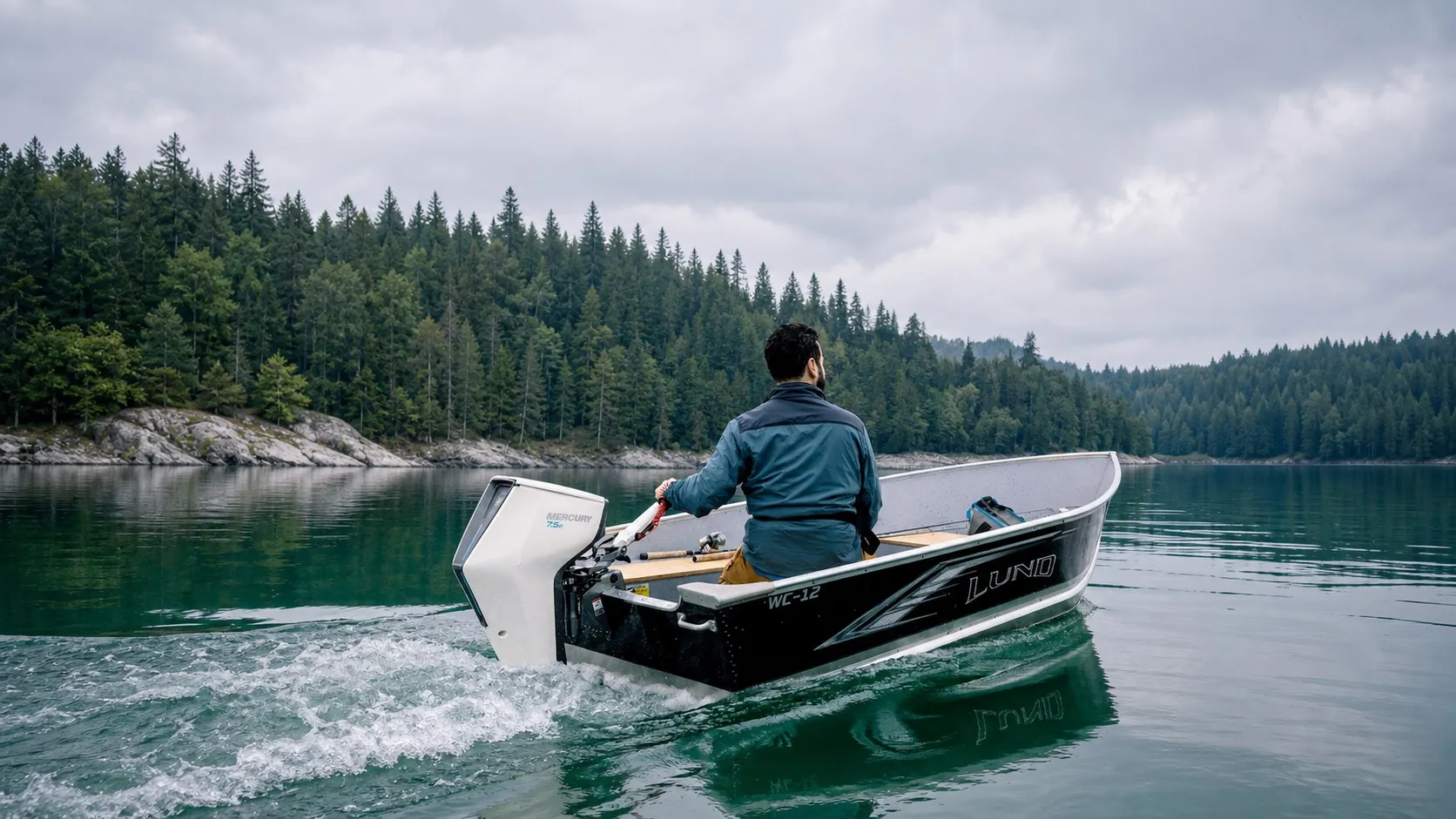
Mercury Avator Electric Outboards: What They Are, What They Cost, and Who They're Actually For Electric outboards aren't a someday thing.
Note: HBW doesn't sell Avator yet; we may add it in a future season. Our Avator page has the model table and battery notes.
Quick answer: Mercury's Avator electric line runs from the 7.5e (rated 750 W) up to the 110e (rated 11 kW), suited to canoes, tenders, small fishing boats, and pontoons. Range trades against throttle: Mercury's 7.5e test on a 13-foot boat ran about 60 minutes at full throttle or up to 19 hours at 25%. HBW doesn't sell Avator yet; we may add it in a future season.
Mercury Avator Electric Outboards: What They Are, What They Cost, and Who They're Actually For
Electric outboards aren't a someday thing. Mercury's Avator line is out, we're a Mercury dealer, and we get asked about it enough that it's worth laying out straight: what these motors do, what they don't, and whether one belongs on the back of your boat. No hype. Just what we know.
The Avator lineup, in plain terms
Mercury rates Avator models by prop-shaft power in watts or kilowatts, not by gas-engine horsepower. Here is the current lineup:
| Model |
Rated prop-shaft power |
Best for |
| Avator 7.5e |
0.75 kW |
Canoes, dinghies, small tenders, trolling |
| Avator 20e |
2.2 kW |
Small fishing boats, inflatables |
| Avator 35e |
3.7 kW |
Small fishing boats, light tenders |
| Avator 75e |
7.5 kW |
Small pontoons, larger tenders |
| Avator 110e |
11 kW |
Pontoons, day boats |
Those are rated prop-shaft figures, not a promise that an Avator will behave like a gas outboard with a particular horsepower number. Hull, load, propeller, battery configuration, wind, and throttle setting all affect thrust, acceleration, range, and runtime. Compare the exact boat setup instead of converting kilowatts into a gas-horsepower shortcut.
A few things worth knowing: the 7.5e battery (1 kWh, about 8 kg (17 lb)) slides in under the cowl with no cables, and you can carry a spare and swap it in seconds. The bigger 75e and 110e use a Power Center hub that connects up to four larger 5,400 Wh batteries, so range scales with how many packs you buy.
The honest part: range
This is the question that matters, and the answer is "less than a tank of gas, and it depends." In Mercury's published 7.5e testing on a 13-foot Veer V13 (382-lb dry hull weight) with one 1 kWh battery, it ran about 60 minutes / 5 miles at full throttle, or up to 19 hours / 34 miles at 25% throttle.
Those are Mercury's test results, not a minimum or maximum for your boat. Your hull, load, throttle setting, wind and chop can change both range and runtime, including reducing range below the full-throttle test result. Plan a return reserve for your conditions and carry a spare battery if you're going far.
Charging
Charge time depends on the model and which charger you have. The small 7.5e ships with a 110W charger that refills its 1 kWh battery in roughly 9 hours; an optional 520W charger cuts that to about 2 hours. The bigger 75e and 110e use much larger 5,400 Wh battery packs: the portable 520W charger takes roughly 20 hours to refill two of them, and the 1050W charger cuts that by more than half but needs a proper AC inlet and breaker. For a cottage with a dock outlet, overnight charging is fine. For anyone without shore power, it's a real consideration.
What's genuinely good about it
- No fumes, no pull-start, no oil changes, no winterizing the fuel system. For a small kicker or tender motor, that's a real quality-of-life upgrade.
- Quiet. On a calm morning you'll hear the loons, not the motor. Anglers like this more than they expect to.
- Instant torque. The transverse-flux motor pulls hard off the line for its size.
- The display and app show real-time range in distance or time remaining, so you're not guessing how far home is.
Who it's actually for
Be honest with yourself about how you boat.
An Avator makes sense if you run a small boat, canoe, or dinghy short distances; you want a clean, quiet trolling or tender motor; you've got a dock outlet to charge at; and lower maintenance appeals to you more than maximum range. Avator still needs the inspections, anode checks, lubrication and battery/storage care specified in the exact model manual.
Stick with gas if you cover real distance, run a heavier boat, fish all day far from shore, or don't have reliable charging. A 9.9 or 15 hp Mercury FourStroke still does more, goes farther, and refuels in two minutes at the pump. There's no shame in that being the right answer: for most Rice Lake boats today, it still is.
What about price?
Avator pricing depends on the model, battery count, charger, controls and installation. HBW doesn't sell Avator yet; we may add it in a future season. The right battery count depends entirely on your boat and how you use it, and our Avator page walks through the options.
For gas outboards, the configurator does what it always does: build a real Mercury quote in 2 minutes at mercuryrepower.ca.
Related Avator reading:
Family-owned since 1947, Mercury dealer since 1965, Mercury Premier Dealer.