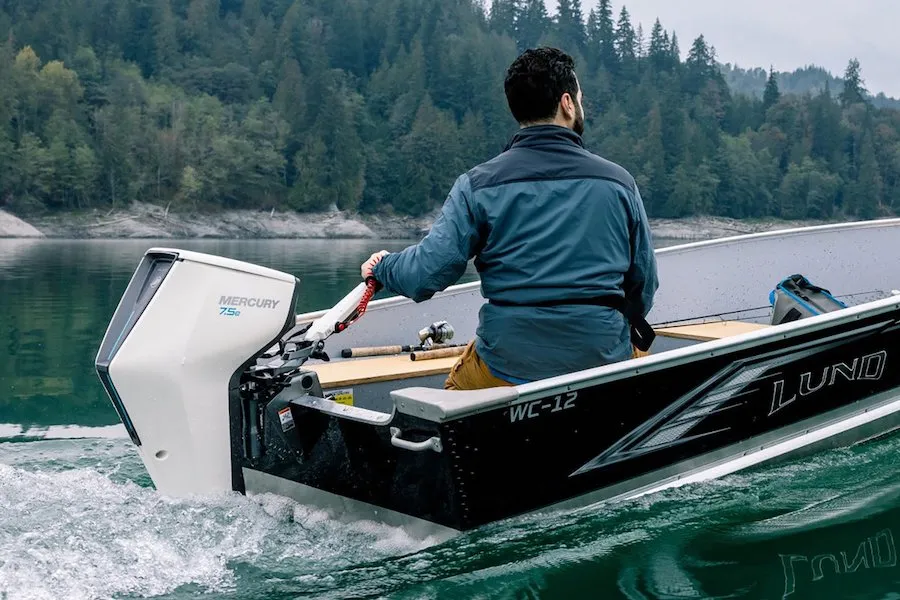
Hero image: Mercury Avator 7.5e on a Lund boat. This photograph illustrates the outboard in use; it does not show a charging installation. > Now at HBW: Mercury Avator is in our lineup. See Mercury Avator prices in Canada for the model table, battery notes, and the quote...
Hero image: Mercury Avator 7.5e on a Lund boat. This photograph illustrates the outboard in use; it does not show a charging installation.
Now at HBW: Mercury Avator is in our lineup. See Mercury Avator prices in Canada for the model table, battery notes, and the quote path.
Quick Answer
Charging a Mercury Avator at a typical Ontario cottage works fine if you have reliable shore power. Mercury's Avator 7.5e page confirms that the included 110 W charger uses a standard household outlet. Its current Avator family brochure lists about nine hours from fully depleted, with charging time varying by battery state and temperature. Plan on an overnight charge unless you select a compatible faster charger. Larger Avator models use different battery and charger combinations, so confirm the package and electrical requirements before planning turnaround time. The deciding factors are how many battery packs you're charging, how often you're running the motor, and whether your cottage has the electrical capacity for simultaneous charging.
What charging actually requires
A Mercury Avator charging setup needs three things:
- A reliable power source: typically shore power at the dock or boathouse
- The correct charger for your battery configuration: Mercury's chargers come in different output ratings
- A protected outdoor outlet: GFCI-protected, rated for outdoor use, weatherproof
For a cottage with existing dock or boathouse power, the setup is usually straightforward. For a cottage without dock power, you're either running an extension cord from the house (works for small Avator models, awkward for larger ones) or having a marine electrician install a dedicated dock outlet.
Charge times by Avator model
Avator 7.5e (integrated 1 kWh battery)
- Included 110 W charger with a standard household outlet: about nine hours from fully depleted
- Optional faster charger: confirm the current compatible charger and input requirements with Mercury
For typical cottage use (a few hours on the water, then dock for the night), the 7.5e's overnight 110V charge is comfortable.
Avator 20e and 35e (external 2,300 Wh packs, up to 4 packs)
- Standard household outlet, single pack: about 10 hours from fully depleted on the 230 W charger, and the 520 W charger cuts that by more than half
- Higher-output charger, single pack: confirm the current compatible charger and pack with Mercury before planning turnaround time
- Multiple packs simultaneously: depends on charger configuration
For multi-pack setups, overnight 110V charging works if you have outlets to spare. A single 240V charger is the better answer for serious use.
Avator 75e and 110e (Power Center system, 5,400 Wh packs)
- Standard 110V: practical only for trickle charging or single-pack maintenance
- Charger options: Mercury lists a portable 520 W charger (about 20 hours for two depleted 5,400 Wh batteries) and a vessel-integrated 1 kW charger that cuts that time by more than half
For Avator 75e or 110e, confirm the input requirements of the charger you select and plan your cottage electrical around it.
The cottage electrical reality
Most Ontario cottages were built with electrical service designed for cottage loads, lights, basic appliances, water pump, maybe an air conditioner. Adding Avator charging on top of normal cottage use needs some planning:
100A service cottage: plenty of capacity for Avator charging on top of normal loads. Add a dedicated dock outlet, you're done.
60A service cottage: usually enough for Avator 7.5e or single-pack 20e/35e charging. Larger multi-pack setups may push the panel limits when running other loads simultaneously.
Off-grid or remote cottage: Avator generally doesn't work without shore power. Solar charging is theoretically possible but the math rarely works out for serious use. Plan on a gas outboard for off-grid cottages.
A marine electrician can assess your cottage panel and tell you what your realistic Avator charging options are. Worth the $200-300 consultation before buying a large Avator setup.
Dock outlet installation
For a dedicated Avator charging outlet at the dock:
- GFCI-protected: mandatory for outdoor outlets near water
- Weatherproof in-use cover: the outlet stays sealed even with a plug inserted
- Properly grounded: marine-grade grounding to prevent stray current corrosion
- Wire gauge rated for the load: typically 12 AWG for 20A circuits, heavier for 240V
Have a licensed electrician do the dock outlet install. Marine electrical near water is one of the few areas where a DIY approach creates real safety risk. Cost varies a lot with the run length and panel condition, so get a quote from a licensed electrician; a 240V install or panel work runs well above a basic 110V outlet.
Charging logistics for cottage trips
For weekend cottagers running Avator:
Arrive Friday evening with battery at 50%: drive up after work, motor sits on the trailer. Charging starts Friday night.
Saturday morning: battery fully charged. Run the motor through the day.
Saturday evening: dock the boat, plug in. Battery charges overnight.
Sunday: battery fully charged for Sunday running.
This pattern works fine with overnight charging for most Avator models. The single-day "I'll run all day Saturday and Sunday" pattern is where charging becomes a constraint, you need a higher-output charger to turn the battery around fast enough.
Cold weather and off-season charging
Avator batteries lose meaningful capacity in cold weather. Late-season operation (October-November on Ontario lakes) means reduced range and slower charging.
For off-season storage (December-March), Mercury's Avator manual says to fully charge packs before storage, and again every six months if storage lasts longer than six months. Never let them sit below 20% charge. Remove the packs from the boat and store them in a dry, ventilated, temperature-stable room between 0 and 25°C.
This is one of the practical differences from gas: a gas outboard can sit at the cottage through winter (properly winterized). An Avator setup means battery packs come home to a heated garage every fall.
What we see at HBW
The most common cottage Avator setup question we get: "Can I just run an extension cord from the house?"
For the Avator 7.5e, yes, a heavy-gauge outdoor extension cord (12 AWG or better, rated for the length) works for a small Avator's overnight charging. Not ideal but functional.
For larger Avator setups (35e and up), an extension cord becomes impractical. Voltage drop over long runs reduces charge rate, and running heavy cords through cottage traffic patterns creates trip hazards. For these setups, a proper dock outlet install is the right answer.
The other common situation: cottagers who add Avator without consulting their cottage electrical capacity. The first big charge cycle blows a breaker, the panel needs upgrading, and the project that was supposed to be "buy a quiet electric motor" becomes "rewire the cottage." Have an electrician check your panel capacity before you commit.