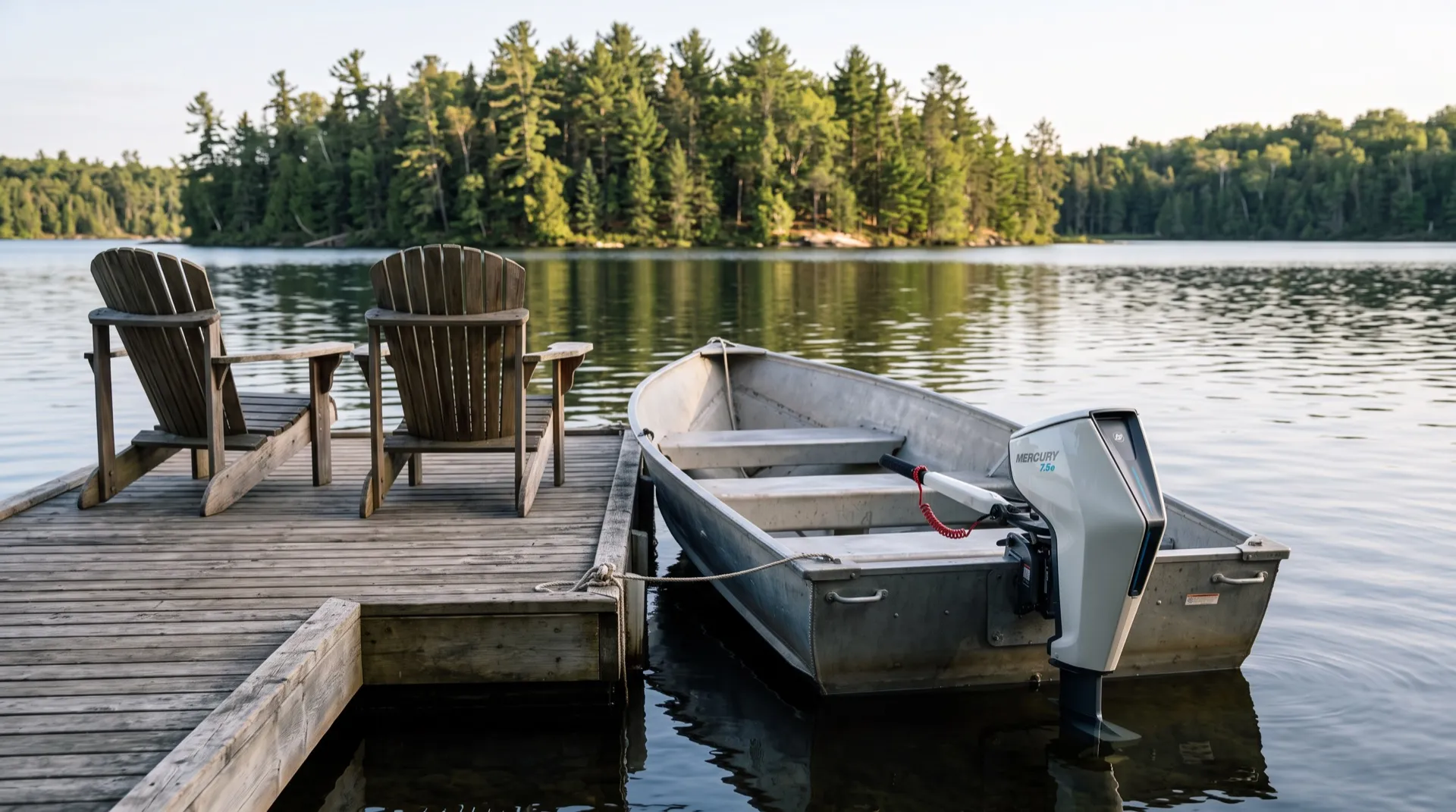
Quick Answer A Mercury Avator electric outboard's real-world range on Rice Lake depends on the boat, load, weather, throttle setting and battery configuration. Mercury's published 13-foot test reached about 5 miles at full throttle and 34 miles at quarter-throttle. For...
Now at HBW: Mercury Avator is in our lineup. See Mercury Avator prices in Canada for the model table, battery notes, and the quote path.
Quick Answer
A Mercury Avator electric outboard's real-world range on Rice Lake depends on the boat, load, weather, throttle setting and battery configuration. Mercury's published 13-foot test reached about 5 miles at full throttle and 34 miles at quarter-throttle. For practical Rice Lake trip planning with a reserve for wind and chop, use roughly 3 to 4 miles at full throttle or 20 to 25 miles at quarter-throttle on a 7.5e with one 1 kWh battery. Larger Avator models with multiple packs extend that meaningfully. The honest take: Avator works for short-range cottage use; it is not the practical choice for a full-day trip covering the lake.
What Is the Range of a Mercury Avator Electric Outboard?
It depends on the model and how many battery packs you run. A Mercury Avator 7.5e on its built-in 1 kWh battery does roughly 3 to 4 miles at full throttle and 20 to 25 miles at trolling speed on Rice Lake. The larger models (20e through 110e) take external packs and extend range by adding batteries. Mercury rates Avators by power output and thrust, not by a gas-horsepower equivalent.
| Model |
Battery setup |
Full throttle |
Half throttle |
Trolling / low speed |
Typical boat |
| Avator 7.5e |
1 kWh integrated |
~3-4 mi |
~8-12 mi |
~20-25 mi |
Under 14 ft |
| Avator 20e |
Up to 3 external 2,300 Wh packs |
Similar to 7.5e per pack |
Similar to 7.5e per pack |
Scales with pack count |
14-16 ft aluminum |
| Avator 35e |
Up to 4 external 2,300 Wh packs |
~6-8 mi |
~15-20 mi |
Scales with pack count |
14-18 ft |
| Avator 75e |
Up to 4 packs, 5,400 Wh each |
Scales with pack count |
Scales with pack count |
Scales with pack count |
16-20 ft |
| Avator 110e |
Up to 4 packs, 5,400 Wh each |
Scales with pack count |
Scales with pack count |
Scales with pack count |
16-20 ft |
Ranges are practical Rice Lake estimates and depend on load, wind, and how many packs are aboard. The 75e and 110e scale with the number of 5,400 Wh packs installed; see each model's section below for the detail.
What "range" actually means on an electric outboard
Range on an electric outboard depends on:
- Battery capacity (kWh)
- Throttle setting (full throttle drains the battery much faster than quarter-throttle)
- Boat weight + passengers + gear
- Hull efficiency (a flat-bottom aluminum is more efficient than a heavy V-hull)
- Water and weather conditions (chop and wind reduce range significantly)
- Battery temperature (cold water lowers usable capacity)
Mercury's published Avator range numbers are honest in the sense that they reflect specific test conditions. But "5 miles at full throttle" doesn't mean "5 miles of useful range in real conditions." Plan on 60-70% of Mercury's published numbers for realistic Rice Lake conditions. If you're also cross-shopping Torqeedo, we put the two side by side in our Avator vs Torqeedo breakdown.
Avator range on Rice Lake by model
Avator 7.5e
Built for small car-toppers and tenders, boats under 14 ft. Single integrated 1 kWh battery.
Real-world Rice Lake range:
- Full throttle: ~3-4 miles practical
- Half throttle: ~8-12 miles practical
- Quarter throttle: ~20-25 miles practical (mostly trolling speeds)
Use case fit: A small fishing boat moving between docks on the south or east shore of Rice Lake. A cottage tender running short trips. Not enough for a full-day fishing trip that crosses the lake multiple times.
Avator 20e
Mid-tier compact electric, supports external 2,300 Wh battery packs (up to 3).
Real-world range with 1 external pack: similar to 7.5e numbers, but on slightly larger boats.
Real-world range with 3 packs: 2-3x the single-pack range.
Use case fit: A 14-16 ft aluminum cottage boat making short to medium-range trips. Adding battery packs is how you extend range, at significant cost.
Avator 35e
Designed for 14-18 ft boats, supports up to 4 external 2,300 Wh packs.
Real-world Rice Lake range with 2 packs:
- Full throttle: ~6-8 miles practical
- Half throttle: ~15-20 miles practical
Use case fit: Mid-size cottage boat doing short to medium runs. Sufficient for most Rice Lake cottage day-trip patterns if not running full throttle constantly.
Avator 75e and 110e
Larger Power Center battery system, supports up to 4 packs of 5,400 Wh each.
These are the only Avator models in serious consideration for primary outboard duty on a mid-size (16-20 ft) Ontario freshwater boat. Even then, the practical range is shorter than gas-powered equivalents, and charging logistics are a real factor.
The Rice Lake cottage use case
Most Rice Lake cottagers run trips that fall into one of three patterns:
Short hop: dock to neighbour's dock, dock to nearby fishing spot, dock to swimming bay. Often under 2 miles round trip. Even the smallest Avator handles this comfortably.
Half-day: out for a morning fishing trip, lunch back at the dock, maybe an evening run. 5-10 miles total over a few hours. Most Avator models with 2+ battery packs handle this.
Full-day: out for 6-8 hours, multiple fishing spots, crossing the lake, running back into wind. 15-25+ miles total. This is where Avator stops being practical for most setups.
For the first two patterns, Avator works. For the third, plan on running a gas outboard with a trolling motor as the better answer.
Charging at the cottage
Charging is half the Avator equation. Mercury's Avator 7.5e page confirms that the included 110 W charger uses a standard household outlet. Its current Avator family brochure lists about nine hours from fully depleted, with charging time varying by battery state and temperature. Plan on an overnight charge unless you select a compatible faster charger. Larger external battery packs take longer, so confirm the charger and pack combination before planning turnaround time.
What that means in practice:
110V cottage with multiple outlets: works for overnight charging of 1-2 packs simultaneously. Standard cottage electrical handles this fine.
110V cottage with limited outlets: bottleneck. Charging 3-4 packs from one outlet means rotating them through overnight cycles. Manageable but requires planning.
240V cottage: a 240V charger drops charge time meaningfully. Worth investing in if you're running an Avator 75e or 110e with multiple packs.
Remote / off-grid cottage: Avator becomes impractical. Solar charging is theoretically possible but the math is rough. If your cottage doesn't have reliable shore power, plan on gas.
The honest comparison
For Rice Lake cottage applications, the Avator vs gas outboard decision usually comes out like this:
| Use Pattern |
Avator |
Gas Outboard |
| Short hops, dock-to-dock |
Excellent fit |
Overkill |
| Half-day light use |
Good fit |
Standard answer |
| Full-day fishing crossing the lake |
Range limited |
Standard answer |
| Multi-day trips without charging access |
Doesn't work |
Standard answer |
| Quiet operation (early morning fishing) |
Major advantage |
Normal engine noise |
| Low maintenance |
Major advantage |
More service required |
| Cottage charging logistics |
Required infrastructure |
None |
| Cold weather operation |
Reduced capacity |
Standard |
What we see at HBW
Most of our Rice Lake Avator conversations end with the customer keeping their gas outboard and adding an Avator as a second small boat. The Avator-on-a-small-boat-for-quiet-mornings is a great use case. The Avator-as-primary-outboard-on-a-Rice-Lake-fishing-boat is a setup that works only for very specific cottage patterns.
The customers who have made primary-Avator setups work are typically running smaller boats (14-16 ft), staying close to their dock, and have reliable cottage shore power for overnight charging.
For most Rice Lake fishing patterns covering significant distance, gas outboard plus a trolling motor remains the right tool.