Quick answer Both Mercury and Suzuki make mechanically reliable four-stroke outboards in 2026. Maintain either properly and expect 15 to 25 years of useful life. In Ontario freshwater, the real deciding factor is service access: who services it and how close they are.
Quick answer
Both Mercury and Suzuki make mechanically reliable four-stroke outboards in 2026. Maintain either properly and expect 15 to 25 years of useful life. In Ontario freshwater, the real deciding factor is service access: who services it and how close they are. We are a Mercury dealer since 1965 and do not sell or service Suzuki.
Conflict-of-interest disclosure
Harris Boat Works is a Mercury Marine Premier dealer in Gores Landing, Ontario. We have been a Mercury dealer since 1965. We do not sell Suzuki and we do not service Suzuki. For engine repairs, we only service Mercury and MerCruiser.
This page reflects our honest read of the Ontario market from a Mercury dealer's perspective. The Suzuki content below comes from public information, customer-side reports we hear when prospective customers describe what they were quoted elsewhere, and observed market behaviour in the Kawartha and Rice Lake region. If you want a Suzuki dealer's view of Suzuki, ask a Suzuki dealer.
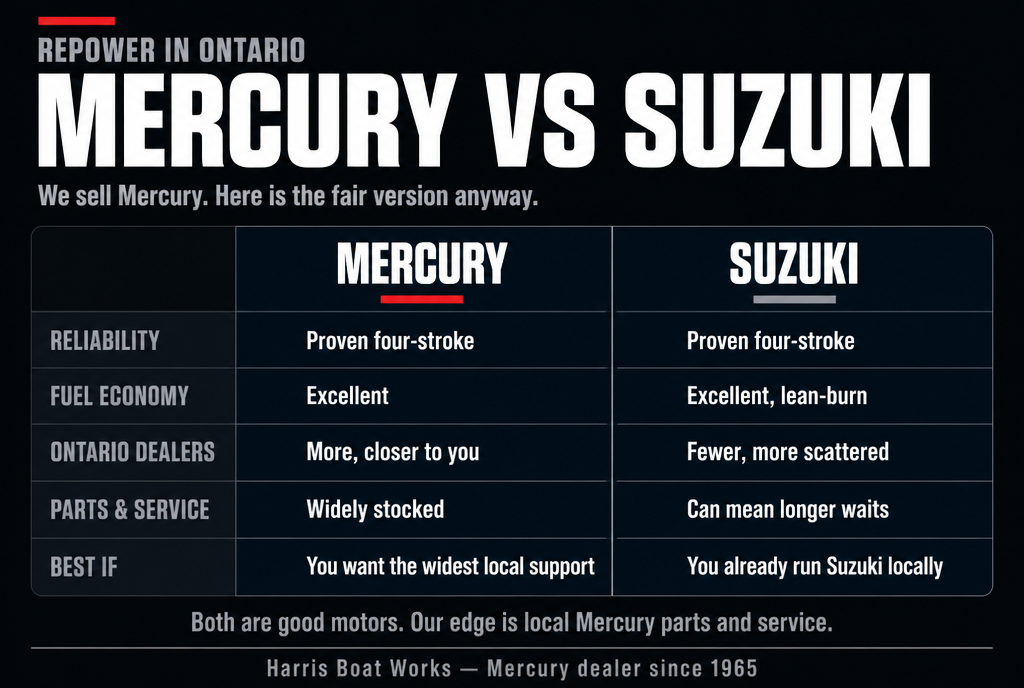
The bottom line for Ontario freshwater
Both Mercury and Suzuki build mechanically reliable four-stroke outboards in 2026, and a well-maintained example of either will outlast most hulls. The decision in Ontario rarely turns on the motor. It turns on service access: how far you are from an authorized dealer with parts on the shelf when something goes wrong in late June. In the Kawarthas and Rice Lake region that factor favours Mercury heavily; in a region with strong Suzuki dealer coverage, it may not. Match the brand to your service map, not to the spec sheet.
Mechanical reliability in 2026
Both Mercury and Suzuki make mechanically reliable four-stroke outboards in 2026. There is no meaningful defect-rate difference between the two brands that should rule either one out on reliability grounds alone.
We say this because the question we get asked most often is some version of "is Brand X actually more reliable than Brand Y?" The honest answer for both brands is: not really, in the sense the question is usually asked. Both run for 15 to 25 years of useful life on Ontario freshwater when properly maintained. Both are engineered well enough that catastrophic failure is rare. Both have customer bases that include thousands of Canadian boat owners who have run their motors for a decade or more with no major issues.
What we hear that actually predicts motor longevity is not the brand. It is the maintenance habits of the owner.
The factor that actually matters: dealer network
The real difference between Mercury and Suzuki in Ontario is not the motor itself. It is the service network behind it.
Mercury has broad dealer coverage across the Kawarthas, the GTA and Ontario cottage corridors. That gives many owners multiple service options, but parts inventory and repair timing vary by dealer and season. Confirm the required part and appointment capacity before changing a trip plan.
Suzuki's Canadian dealer footprint is smaller, and there's no Suzuki dealer on Rice Lake. That's not a knock on Suzuki. It matters most when the motor needs service and you have to arrange a trip to the shop.
For most Ontario freshwater owners, this single factor outweighs almost everything else in the comparison.
Where Suzuki has real advantages
Honest-broker section. Suzuki has genuine strengths that Mercury does not always match:
Model-specific timing drive. Suzuki lists a timing chain on the DF40A and a timing belt on the DF20A. Compare the maintenance schedule for each exact engine instead of assuming a universal belt interval or a guaranteed ownership-cost saving from the drive type alone.
DF-series longevity in commercial use. Suzuki has a strong reputation in commercial fishing and charter applications, particularly in the southern US and the Caribbean. Owners running their motors thousands of hours per year report consistent reliability. This is more relevant to commercial operators than to typical Ontario recreational use, but it is a genuine reliability signal.
Lean-burn EFI fuel-economy claim. Suzuki markets their lean-burn EFI system as a fuel-economy advantage in cruise conditions. Real-world fuel consumption depends heavily on prop selection, hull, load, and operating style, so we will not promise a specific percentage gain to a Canadian buyer. But the engineering is real and Suzuki has emphasized it for years.
Warranty terms. Both manufacturers publish three-year base warranties on current four-stroke models. Suzuki Extended Protection and Mercury Product Protection both extend coverage beyond that. The specific dollar amounts and coverage details change, so check the current published terms at the dealer level before committing.
Where Mercury has the advantage in Ontario
Equally honest. Mercury's real advantages in Ontario specifically:
Dealer density. Covered above. The single biggest factor.
SmartCraft integration. Mercury's current SmartCraft and VesselView ecosystem, integrated gauges, integrated alarm diagnostics, on-water fault codes, is generally regarded as the most mature of the major outboard makers in the consumer space. Suzuki C-10 multifunction gauges exist but the ecosystem is narrower.
Software upgrade roadmap. Mercury Boost is the current example. A dealer-installed software calibration that adds mid-range responsiveness on eligible motors without changing hardware. This kind of upgrade path is, so far, more developed at Mercury than at Suzuki. It also means that an existing Mercury fleet has a path to improved performance without a new motor purchase.
Parts shelf depth. Mercury's parts availability in Ontario is consistently strong. Common service items are on dealer shelves. Less common items are usually one day away.
Resale in Ontario. Mercury-powered boats are common in the recreational market. Resale demand depends on the exact boat, motor, condition, service history and local buyer pool, so compare current listings rather than assuming one brand always wins.
The Mercury vs Suzuki comparison table
| Factor |
Mercury |
Suzuki |
| Mechanical reliability (2026) |
Strong |
Strong |
| Useful life (properly maintained) |
15 to 25 years |
15 to 25 years |
| Ontario dealer density |
High |
Moderate |
| Kawarthas / Rice Lake service access |
High |
Limited |
| Freshwater reputation |
Excellent |
Excellent |
| Standard warranty |
3 years |
3 years |
| Extended warranty program |
Mercury Product Protection |
Suzuki Extended Protection |
| Timing system |
Mix of chain and belt by model |
Timing chain on most current models |
| Software upgrade pathway (eligibility) |
Yes (Mercury Boost) |
Limited |
| SmartCraft / digital integration |
Yes (broad ecosystem) |
Yes (narrower) |
| Parts shelf availability (Ontario) |
Strong |
Moderate |
| Commercial-use reputation |
Strong |
Strong, particularly DF-series |
| Resale in Ontario (recreational) |
Strong, deep buyer pool |
Strong, smaller buyer pool |
| Rigging cost if switching brand |
n/a if staying Mercury |
$2,000 to $3,000 CAD |
Prices here are planning figures as of October 2026. For live Mercury motor pricing, see the Mercury pricing reference.
Common matchups people cross-shop
These are the head-to-head classes we hear about most often from Ontario shoppers, and the factors that actually settle them.
90 to 115 HP class. This is the aluminum fishing boat and small pontoon heartland, and the decision usually comes down to service access and resale. In the Kawarthas and Rice Lake region, Mercury has many nearby service options and a familiar resale market. If you are switching brands on a repower, add the rigging conversion cost to the comparison before you decide.
150 HP class. Bigger pontoons, bass boats, and family runabouts. Digital integration starts to matter here: if you want SmartCraft gauges and the software upgrade pathway, that points to Mercury; if your local Suzuki dealer is strong and close, that is a legitimate counterweight. Intended use and dealer proximity decide this class more often than anything on a brochure.
200 HP and up. At this level the boat is a serious investment and downtime is expensive. Service access during the season, parts shelf depth, and the resale pool dominate the decision. Rigging conversion cost on a brand switch is proportionally smaller at this price point but still real; get it quoted as its own line item.
We won't stage a spec battle here; both brands publish their numbers and they are close. The deciding factors are the ones above.
Weight and the transom reality on repowers
Outboard weight varies more by model and configuration (shaft length, steering, gearcase) than by brand. On a repower, the hard limit is your boat's capacity plate: the maximum motor weight printed there is not a suggestion. For Mercury figures, see our Mercury outboard weight chart, and remember that dry weight is not installed weight; controls, propeller, and fluids add to what the transom actually carries. For Suzuki weights, go to Suzuki's own published spec pages rather than third-party numbers.
What a brand switch costs in Ontario
If you currently run Mercury and you are considering Suzuki (or vice versa), the cost of switching is not just the motor. The full repower cost typically includes the motor itself, replacement rigging, controls, gauges, harnesses where they are brand-specific, adapter or replacement steering link where required, and labour for the rigging conversion.
The rigging conversion alone adds a real line on top of the new motor purchase, and the exact CAD figure varies by rigging, so price it in a live quote at mercuryrepower.ca. Brand-switch rigging costs real money in both directions, Mercury-to-other-brand and other-brand-to-Mercury, and it's worth pricing before you commit. It does not always show up on a comparison shopper's spreadsheet, but it should.
If you are coming from a Mercury and you are happy with the current motor's running performance and dealer support, the rigging switch cost is usually the line item that tips the decision toward staying. If you are coming from a Suzuki and your nearest Suzuki dealer is 90 minutes away, the rigging switch cost is the line item that justifies the change.
Five questions to determine the right brand for you
If you are choosing between Mercury and Suzuki on a new boat or repower, work through these five questions before you sign:
- How far is the nearest authorized service dealer for each brand? Driving 30 minutes vs. 90 minutes for warranty service is the most undercounted factor in long-term ownership cost. Check both networks yourself: Mercury's dealer locator at mercurymarine.com and Suzuki's at suzuki.ca both list authorized marine dealers; map the drive from where the boat actually lives.
- What does the nearest dealer's parts shelf look like? Common service items on the shelf is good. Common service items always backordered is bad. Either dealer will tell you the honest answer if you ask plainly.
- What is the rigging conversion cost if you are switching brands? Budget $2,000 to $3,000 CAD on top of the motor purchase if you are leaving your current brand. Confirm with the receiving dealer.
- What is your motor going to do for the next 15 years? Recreational weekend use, charter or rental, commercial work, high-hour repeat use. Different brands have different sweet spots in different categories.
- Where do you launch and where do you keep the boat? Local dealer support is a function of where you actually use the motor, not where you bought it from.
The motor matters. The support behind it matters more.
When it makes sense to switch to Mercury
We will be plain about our bias here. From a Mercury dealer's perspective, a switch from Suzuki (or any other brand) to Mercury usually makes sense when the current brand's nearest service dealer is far enough away that mid-season warranty work is impractical, when the boat is being repowered and the rigging is going to be touched anyway (lowering the marginal cost of the brand switch), when the owner values SmartCraft integration and the software upgrade pathway, when the owner plans to keep the boat for 10+ years and dealer continuity matters, or when the customer values local dealer relationships and Mercury has a closer dealer.
Conversely, staying with the current brand usually makes sense when the current motor is running well and the dealer relationship is solid, when the rigging investment is significant and would have to be redone, when the current brand's local dealer is closer than the nearest Mercury dealer, or when the owner has specific preference for a feature unique to the current brand.
Either decision can be the right one depending on the customer's situation. We are not in the business of talking people into switching brands when their current setup is working.
Family-owned on Rice Lake since 1947.
Weighing a switch? Build a Mercury quote for your boat in about three minutes at mercuryrepower.ca/quote/motor-selection.
