Same hull. Same 60 horsepower. Very different result. In an HBW comparison on Rice Lake, a 16-foot Legend with a standard-gearcase Mercury 60 ran 6 mph faster than a 16-foot Legend with a Command Thrust 60. Jay Harris confirms that result, but the propeller details were not...
Quick answer: The Mercury 60 HP FourStroke is a quiet, compact and well-proven choice for many 15-to-17-foot Ontario fishing boats. Use the standard gearcase for most planing V-hulls. Choose Command Thrust when a pontoon or heavy, high-drag hull needs a larger propeller and more load-carrying grip.
Same hull. Same 60 horsepower. Very different result.
In an HBW comparison on Rice Lake, a 16-foot Legend with a standard-gearcase Mercury 60 ran 6 mph faster than a 16-foot Legend with a Command Thrust 60. Jay Harris confirms that result, but the propeller details were not retained. It is a shop observation, not a controlled test isolating the gearcase or a promised speed difference for another boat.
Command Thrust is a tool for a specific job, not a worse motor. On a small pontoon, barge or heavily loaded workboat, its larger gearcase can be exactly what the boat needs. On a light recreational V-hull, it can be extra drag with no useful job to do.
That distinction is the heart of this review. The current Mercury 60 is a good mid-range outboard. Buying the right version, mounting it properly and finishing the propeller setup matter more than the badge on the cowling.
What the Current Mercury 60 Actually Is
The current Canadian Mercury 60 FourStroke is a 995 cc inline-four with electronic fuel injection, an eight-valve single-overhead-cam layout and a published full-throttle operating range of 5,500 to 6,000 rpm.
It sits at the top of Mercury's 40, 50 and 60 HP family and uses a different powerhead from the larger 2.1-litre block in the 75, 90 and 115.
Current family specifications include:
On a phone, swipe the table sideways to see every column.
| Specification |
60 Standard |
60 Command Thrust |
| Displacement |
995 cc |
995 cc |
| Cylinders |
Inline four |
Inline four |
| Fuel system |
EFI |
EFI |
| Gear ratio |
1.83:1 |
2.33:1 |
| WOT range |
5,500–6,000 rpm |
5,500–6,000 rpm |
| Lightest published dry weight |
247 lb / 112 kg |
260 lb / 118 kg |
| Alternator |
18 amp / 226 watt |
18 amp / 226 watt |
Those weights are Mercury's lightest-version dry figures, not a promise for every shaft length and control configuration. The family is offered with 20- and 25-inch shafts, tiller or remote steering, and different trim arrangements. The exact Canadian model code still has to match the boat.
The same caution applies to what comes in the box. Don't assume a propeller, controls, gauges, battery or fuel tank is included because an online listing somewhere showed one. The written quote for the exact motor and rigging package is the answer.
HBW's current Canadian selection includes standard remote and tiller models, Command Thrust remote and tiller models, and a 25-inch-shaft remote model. Availability changes, so use the live motor selector rather than treating an old dealer listing as a permanent configuration chart.
What It Feels Like on the Water
The 60 is one of those motors that makes a good first impression by not doing anything theatrical.
It starts cleanly. It idles quietly. The four-cylinder layout feels more settled than many smaller twins and triples, especially when you're easing along a weed edge or talking to someone in the boat. At cruise, it can move a sensibly loaded aluminum fishing boat with enough authority that the motor doesn't feel as though it's apologizing for being there.
Nobody should mistake it for a hidden 90. Put four adults, a full livewell, batteries, tackle and a week's worth of cottage supplies into a hull that really wants more power, and 60 horsepower remains 60 horsepower.
The best version of this motor is on a boat whose capacity, load and expectations all agree. On that boat, it feels simple and unstrained. On an overmatched boat, the owner starts shopping for propellers that supposedly manufacture horsepower.
They can't.
What Owners Actually Say Online
We screened public owner discussions, fishing-boat tests and long-term reports for the current 995 cc EFI family. Older two-strokes, carbureted 60s, jet-drive 60/40s and modified ECU motors were excluded.
Owner comments are anecdotal. They're useful for repeated ownership themes, not for calculating failure rates.
Quiet, easy and pleasantly uneventful
Quietness is the comment that keeps coming back. In a Quintrex Renegade 460 test, the standard 60 was described as quiet, smoke-free and easy to live with. In a recent owner discussion comparing 60 HP brands, one commenter also described the Mercury as quieter than the Yamaha. That's one person's comparison, not a controlled sound test.
Routine maintenance gets similar comments. Owners generally describe the oil change as straightforward, with one recurring shop-floor truth: put a rag under the filter unless you want the side of the motor to receive an oil treatment too.
A July 2026 fleet-maintenance post reported five Mercury 60s with more than 1,400 freshwater hours each. The post didn't identify model years or gearcases, so it's encouraging anecdote rather than proof about every current 60. It fits the broader theme: owners tend to like this engine because a serviced one gets on with its job.
The propeller can change the whole review
One Bass Tracker owner reported noticeably better planing and grip in turns after replacing a worn three-blade Black Max with a four-blade Spitfire of the same pitch. The engine had not gained horsepower. The propeller was simply doing a better job of connecting it to the water.
That's why internet reviews of “the Mercury 60” can sound as if they describe different motors. Sometimes they describe different hulls. Sometimes they describe a motor mounted too low. Very often they describe different propellers and loads.
What about the problem stories?
We found isolated reports involving fuel-delivery repairs, idle noises, cooling blockages and gear-lube concerns. They span different years and installations, most leave the gearcase unidentified, and several were never conclusively diagnosed.
Those reports aren't enough evidence to call any of them a recurring current-generation defect.
The useful lesson is less dramatic. If a 60 suddenly loses top-end rpm, overheats after running through sand, or begins making a new noise, diagnose the complete package. Fuel quality, filters, propeller condition, mounting, cooling passages and rigging all belong in the conversation before somebody on a forum declares the powerhead cursed.
Standard vs Command Thrust: Pick the Gearcase for the Job
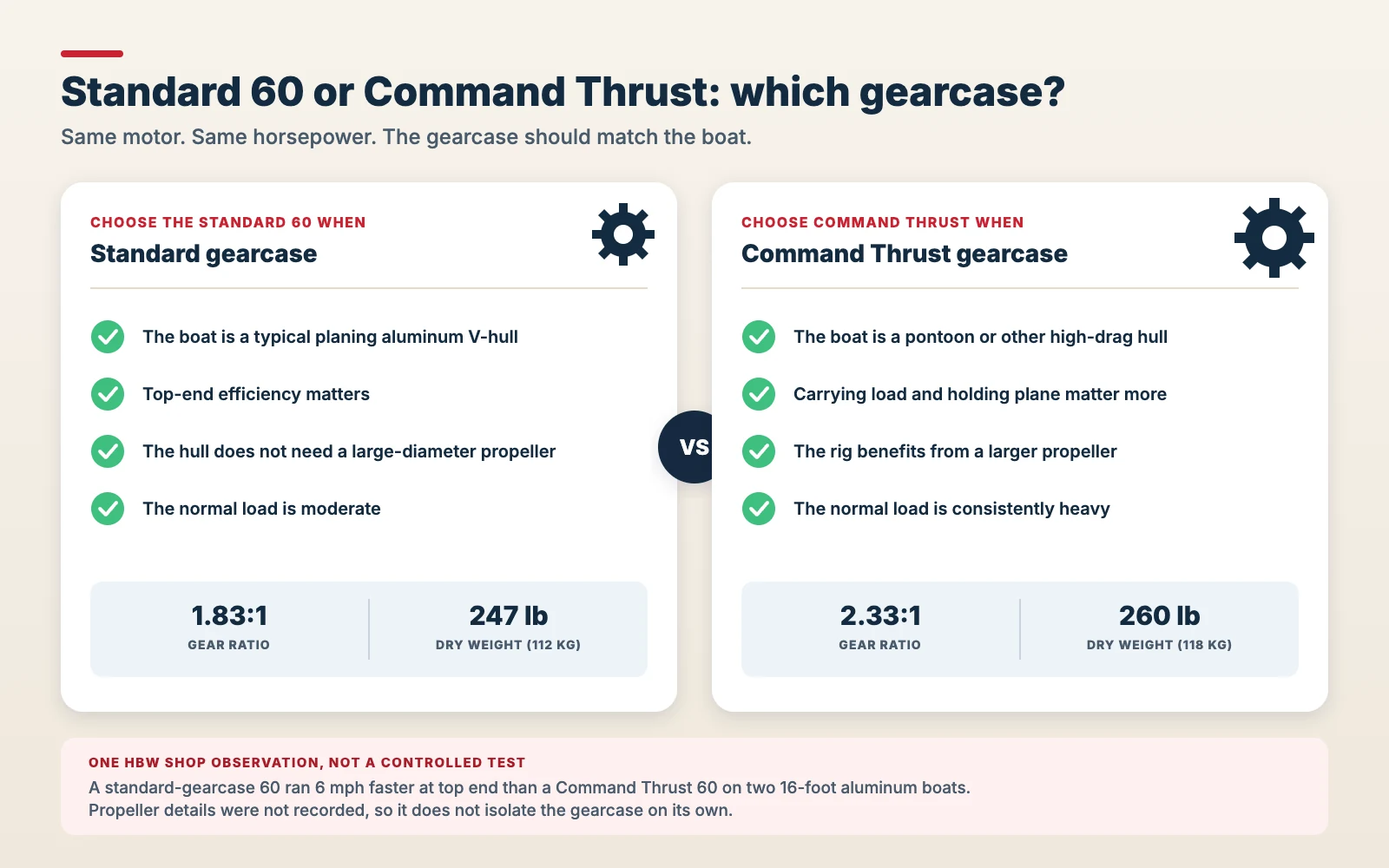
Command Thrust doesn't add horsepower. It gives the 60 a larger gearcase, a 2.33:1 ratio and the ability to turn a larger-diameter propeller.
Mercury 60 HP Command Thrust FourStroke on a freshwater fishing boat. Photo: Mercury Marine.
That combination can help a high-drag or heavily loaded boat get on plane and stay there at a lower speed. It is why Command Thrust makes sense on many small pontoons. It can also be appropriate on a utility boat or work hull where grip and load carrying matter more than the cleanest possible top end.
The standard 1.83:1 gearcase is normally the better starting point for a conventional 15-to-17-foot recreational V-hull. It is lighter and presents less gearcase area to the water.
Our six-mph Legend result is one shop observation, not a controlled test isolating the gearcase. It is a real-world warning against treating CT as a premium upgrade for every boat.
For the engineering history and the cases where the larger gearcase really earns its keep, read our plain-English Command Thrust and BigFoot guide.
On a phone, swipe the table sideways to see every column.
| Choose the standard 60 when |
Choose the 60 Command Thrust when |
| The boat is a typical planing aluminum V-hull |
The boat is a pontoon or other high-drag hull |
| Top-end efficiency matters |
Carrying load and holding plane matter more |
| The hull does not need a large-diameter propeller |
The rig benefits from a larger propeller |
| The normal load is moderate |
The normal load is consistently heavy |
The physical difference, in one line: the Command Thrust gearcase is a larger housing running a 2.33:1 ratio instead of the standard 1.83:1, so it can swing a larger-diameter propeller. The housing is the point, not extra horsepower.
If a salesperson can't explain what the larger gearcase is solving on your boat, “Command Thrust is better” isn't an explanation.
Real Freshwater Results
Speed figures are only useful when the boat and setup remain attached. These are not promises for another hull.
On a phone, swipe the table sideways to see every column.
| Test |
Setup |
Recorded result |
| Mercury Boat House Bulletin 136 |
17.8-ft Crestliner 179 XFC, standard 1.83:1 gearcase, 14-pitch Spitfire, freshwater |
33.0 mph at 5,652 rpm; 0–20 mph in 4.9 sec |
| Mercury Boat House Bulletin 253 |
17.5-ft MirroCraft F170T, standard 1.83:1 gearcase, 12-pitch Spitfire, freshwater |
33.6 mph at 6,098 rpm; 0–20 mph in 5.2 sec |
| HBW shop observation, confirmed by Jay Harris |
Two 16-ft Legend boats with Mercury 60s; one standard gearcase, one Command Thrust; propeller details not retained |
Standard-gearcase boat ran 6 mph faster at top end. This was not a controlled test isolating the gearcase. |
The MirroCraft bulletin recorded 6,098 rpm, slightly above the current published 6,000-rpm upper limit. We wouldn't use that exact setup as a universal target. We included it because it's a transparent Mercury test on a relevant freshwater aluminum boat.
The two factory boats landed around 33 mph. That doesn't mean every 60-powered boat should. A lighter pad hull may run faster. A wide utility boat, pontoon or heavily loaded fishing package may run much slower and still be healthy.
Propeller, Mounting Height and the Final Water Test
Mercury publishes a 5,500-to-6,000-rpm full-throttle range for the current 60. The finished boat should reach the appropriate part of that range with its normal operating load.
A propeller with too much pitch can make the motor feel lazy and keep it below the intended rpm. Too little pitch can send it to the limiter without useful speed. Changing blade count can trade some top end for grip, planing and control in turns.
Mounting height matters too. A motor mounted unnecessarily low creates drag. One mounted too high can lose water pressure or propeller grip. You can't copy the correct answer from another boat simply because both boats are 16 feet long.
This is also why motors 25 HP and up are quoted with a propeller allowance at HBW unless an existing propeller is being reused and proves suitable. We finish the setup on the water, check rpm and handling, and change the propeller when the boat tells us to.
The Mercury propeller selection guide explains pitch, blade count and full-throttle rpm without pretending there is one universal propeller for every 60.
Who Should Buy the Mercury 60?
The 60 belongs on the shortlist when:
- the capacity plate and transom support it
- the boat is commonly a 15-to-17-foot aluminum fishing or utility hull
- the normal load is two or three people with ordinary fishing gear
- quiet trolling, cottage running and easy ownership matter more than maximum speed
- you want the smoothness of an inline-four without moving into the much heavier 75-to-115 family
The Command Thrust version belongs on the shortlist when the same 60 horsepower must push a smaller pontoon or a heavy, high-drag load.
If your real question is whether the boat needs 40 or 60 horsepower, use the separate Mercury 40 vs 60 HP sizing guide. That page owns the horsepower decision; this review owns the current 60 itself.
If the capacity plate also allows 75 HP, the dedicated Mercury 75 HP review explains what the larger 2.1-litre platform changes. For a broader capacity-plate, load and use-case framework, start with how to choose the right horsepower for a boat.
When We Would Tell You Not to Buy the 60
We'd move the conversation down in horsepower if the boat's capacity plate, transom condition or weight limit doesn't comfortably accept the 60.
We'd move it up if the boat is rated for more power and you regularly carry a full family, tow watersports, load a large pontoon or expect effortless acceleration with every seat occupied. A 60 that spends its life at full throttle trying to do a 90's job isn't the economical choice.
We'd also pause if someone wants Command Thrust only because it sounds like the premium version. The larger gearcase should solve a real rigging problem. If it doesn't, choose the standard 60.
What We See at HBW
The current 60 is a very sensible repower for the Ontario boats that actually exist in large numbers: aluminum fishing boats, cottage runabouts and utility hulls that don't need triple-digit horsepower.
The motor itself is rarely the confusing part. The decisions around it are:
- Is the transom sound, and what shaft length does it require?
- Does the boat want the standard or Command Thrust gearcase?
- Are existing controls and gauges compatible?
- Is the motor mounted at the correct height?
- Does the final propeller put normal-load rpm where it belongs?
We answer those questions before delivery and verify the finished boat on Rice Lake. The water test is where a complete repower becomes more than a motor bolted to a transom.
Warranty, Product Protection and Live Canadian Pricing
For eligible Canadian pleasure-use purchases, Mercury's current warranty chart lists a three-year limited warranty and three years of corrosion coverage. Those periods run at the same time. They do not stack into six years of full factory warranty.
Mercury Product Protection Platinum is a separate optional service contract for eligible motors that begins after the limited warranty. Available plan length, eligibility, exclusions and promotional coverage can change, so use the current page and written quote rather than an old screenshot.
Motor prices, rebates and financing programs can change too. See the live Mercury pricing reference or build a detailed CAD quote for the current motor, rigging, installation, propeller choice and available promotions.
The Bottom Line
The Mercury 60 FourStroke earns its reputation the unglamorous way. It's quiet, smooth, straightforward to maintain and powerful enough for a large number of Ontario fishing boats.
The honest buying decision comes down to the gearcase, whether 60 horsepower suits the real load, and whether somebody will finish the setup on the water.
Get those three things right and the 60 is the kind of motor owners stop talking about because they are busy using the boat.
Price a Mercury 60 Repower
Build your Mercury quote online to compare current motor and rigging prices.
Address: 5369 Harris Boat Works Rd, Gores Landing, ON K0K 2E0
Harris Boat Works sells, installs, water-tests and services Mercury outboards in Gores Landing on Rice Lake.
Sources and Review Notes
This review was last checked July 28, 2026. Official specifications and factory performance results are separated from HBW's own test and public owner anecdotes.
Official hero photography: Mercury Marine, 60 HP FourStroke on a freshwater Tracker fishing boat.
