Quick answer A Mercury overheat alarm can reflect real heat, Guardian mode, heat soak after a hot shutdown, or a sensor or wiring fault. Drop throttle, check the tell-tale stream, note the display and pattern, and follow the operator manual. Strong flow does not rule out...
Quick answer
A Mercury overheat alarm can reflect real heat, Guardian mode, heat soak after a hot shutdown, or a sensor or wiring fault. Drop throttle, check the tell-tale stream, note the display and pattern, and follow the operator manual. Strong flow does not rule out overheating; weak or no flow means shut down before more damage, and a persistent overheat alarm means shut down and arrange service.
If SmartCraft or VesselView shows a number with the alarm, use the Mercury fault-code lookup for that complete number before interpreting the horn pattern.
Every Pattern, What It Means, and What to Do
Why Overheat Alarms Require Different Responses
An overheat alarm on a Mercury outboard is not a single condition. It is the engine management system telling you that something in the cooling system, the temperature sensor circuit, or the broader engine-protection logic has tripped a threshold. The response depends on which one.
There are four scenarios that produce alarm behaviour HBW customers call us about every season:
- Real heat. The motor is actually running hot. The cylinder head temperature is above the protection threshold. This needs immediate action.
- Guardian mode. The ECM has detected a condition that could damage the motor and is deliberately reducing power output. The alarm is paired with a noticeable drop in RPM or throttle response.
- Heat soak. A one-time key-on alarm after a hot shutdown can be heat soak if it clears as the motor cools AND does not come back; if it returns, logs a fault, or happens under load, treat it as real.
- Sensor or wiring fault. A temperature sensor or its wiring can report incorrectly, but do not assume that from tell-tale flow alone. Confirm with the display, the operator manual, and proper diagnosis.
All four sound the same to the operator. The distinction lives in the pattern, when it happens, and what the engine is doing at the time. That is what the rest of this page is about.
The Overheat Alarm Pattern Table
Work through this in order. Most alarms fall into one of these patterns:
| Alarm pattern |
When it happens |
Likely cause |
Urgency |
First action |
| Continuous alarm at cruise |
Underway, mid-RPM or higher |
Possible real heat or other critical engine condition |
High |
Reduce throttle, read the display and manual, check flow, and shut down if the alarm persists |
| Continuous alarm at startup / key-on |
Right after a hot shutdown |
Heat soak (usually) |
Low |
Wait 5 to 10 minutes for the motor to cool, restart once, confirm it clears. If it returns, do not keep running it; book service |
| Alarm + power reduction (Guardian mode) |
Any RPM, sudden drop in power |
ECM-detected protective action |
High |
Do not override. Follow the display and manual; shut down if overheat persists and diagnose before restarting. |
| Alarm only at WOT |
At wide-open throttle, clears at cruise RPM |
A load or high-flow cooling problem: water pressure, impeller and housing, poppet or pressure valve where fitted, intake screens, or engine height |
Medium |
Check water pressure. Possible service issue. Schedule diagnostic. |
| Intermittent / random alarm |
No clear correlation with RPM or load |
Non-critical condition varies by model and year; sensor or wiring is one possibility |
Medium |
Read the display and manual. Note the exact pattern and conditions for service. |
| Alarm with no power reduction and tell-tale flowing strong |
At cruise |
Cause not established; real heat remains possible |
Medium |
Follow the display and manual. Shut down if the alarm persists and arrange diagnosis. |
| Alarm at idle only |
Idle in shallow / weedy water |
Cooling intake restriction |
Medium |
Lift motor, clear intake, restart |
Important: alarm patterns and what they indicate vary by motor model, year, rigging, and whether the boat is SmartCraft-equipped. The patterns above describe what HBW techs see most often on Ontario Mercury motors from the EFI FourStroke and Verado families. Always confirm against your specific motor's operator's manual and any SmartCraft or VesselView display message.
Follow the warning for the exact engine. Read the operator manual and any SmartCraft or VesselView message. A strong telltale does not rule out overheating, and a beep pattern is not a diagnosis. Have the serial number and displayed message ready when contacting a qualified technician.
The On-Water Emergency Protocol
If an alarm sounds while you are underway, work through these steps in order. This is a HowTo sequence designed for the moment the alarm starts. Six steps. Under 5 minutes.
Step 1, Reduce throttle. Drop to idle or no-wake immediately. Do not keep the motor under load with a warning alarm sounding. Whatever is wrong gets worse the longer you run it hot.
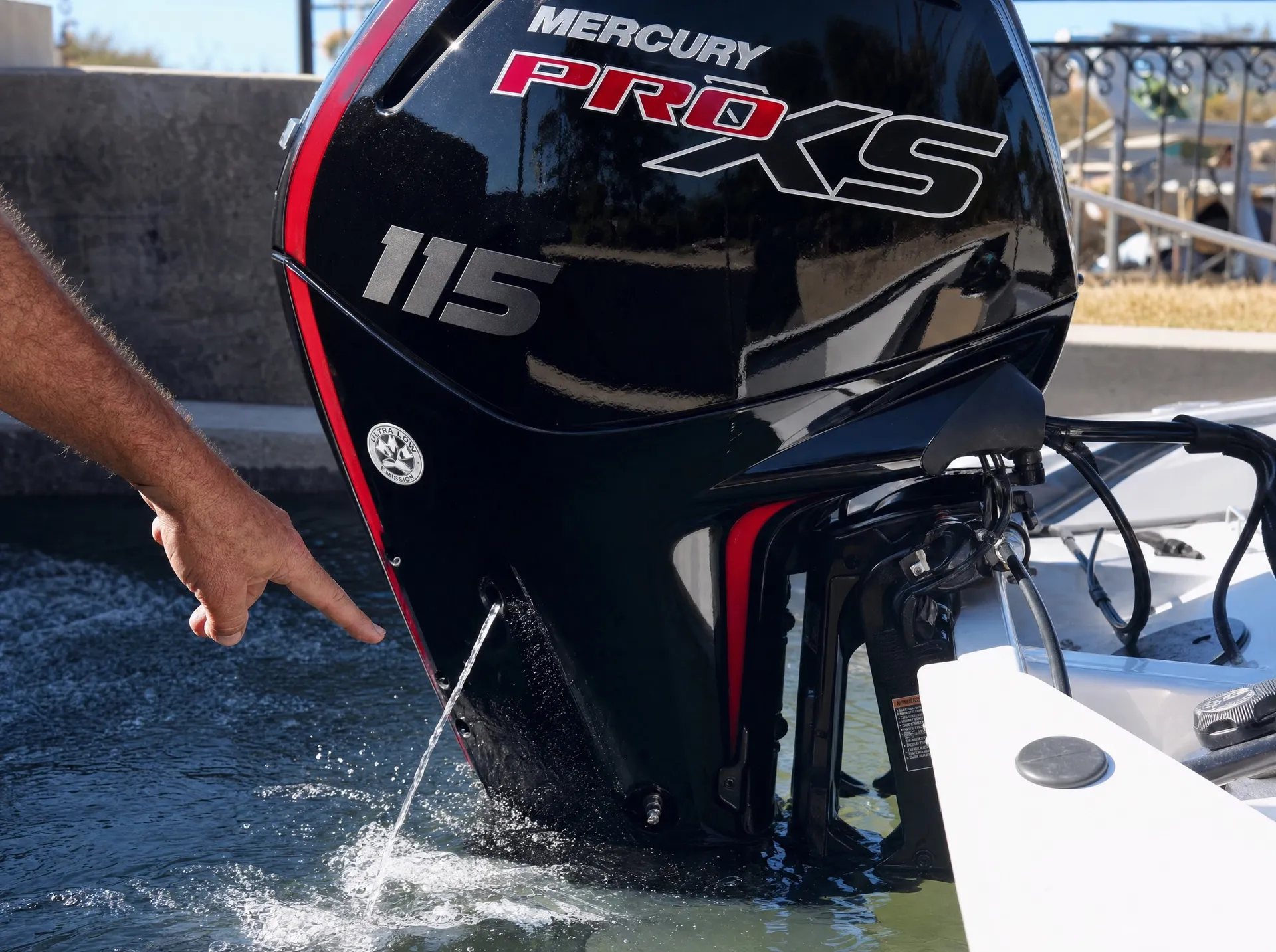
Step 2, Check the tell-tale stream. Look at the cooling water stream coming out of the back of the motor. Is it flowing strong, weak, intermittent, or stopped? A strong telltale only proves the indicator circuit has flow. Mercury's guidance is that an engine that keeps overheating with a steady telltale needs service; compare live SmartCraft temperature and actual head temperature before calling it a sensor. No flow plus alarm points to real heat and a circulation problem.
Step 3, Check the display. If you have SmartCraft, VesselView, or any gauge with engine monitoring, look at it now. Note the exact message or fault code shown. Take a photo. This is the single most useful piece of information you can bring to a technician.
Step 4, Note the alarm pattern. Is it continuous? Intermittent? Did power drop at the same time (Guardian mode)? Did it start at idle, at cruise, or at WOT? Write it down or speak it into your phone right then. You will forget the exact pattern by the time you reach the dock.
Step 5, Decide: shore or shut down. If the tell-tale is weak or stopped, shut down immediately. Strong flow does not rule out overheating; follow the display and operator manual, and shut down if the overheat alarm persists. The cost of a tow back to the dock is much less than the cost of a new powerhead.
Step 6, Do not restart and run hard to "test it." If the alarm cleared after shutdown, it does not mean the problem went away. It usually means the motor cooled enough for the sensor to drop below threshold. Investigate before the next run.
First Diagnostic: Is the Motor Actually Hot?
If a qualified person has an infrared temperature gun, a reading taken at the specified location after shutdown can be one diagnostic clue. Surface readings vary by location, paint and instrument accuracy; the display, operator manual and service data remain the controlling evidence.
If a reliable reading appears inconsistent with the alarm, a sensor, wiring or connector issue is one possibility. Bring the motor in rather than assuming the engine is safe to run.
If the head reads hot: real heat. The problem is somewhere in the cooling system. The next section covers what that usually is.
If you do not have diagnostic tools, use the tell-tale only to identify weak or stopped flow as an immediate shutdown signal. Strong, steady flow does not rule out overheating. Confirm the cause with the display, the operator manual and service diagnostics; an IR reading on a painted head is a sanity check, not a diagnosis.
Interactive: how your outboard stays coolDrag the throttle and switch on a fault to see how each one shows up. Values are illustrative.The Four Most Common Causes of Real Overheating
When the motor is genuinely running hot, the cause is often one of the first three below. The fourth is a diagnostic alternative only after real heat has been ruled out. Less common real causes include low water pressure at wide-open throttle, poppet or pressure-valve faults where fitted, plugged passages, and engine height or aerated water pickup.
1. Intake blockage. Weeds, sand, a plastic bag, or debris caught in the cooling water intake screen on the lower unit. This is the most common cause on Rice Lake and the Kawarthas, especially in shallow weedy bays. Lifting the motor and clearing the intake fixes it on the water.
2. Impeller failure. The rubber impeller in the water pump (in the lower unit) wears out, loses blades, or hardens. Mercury's schedule calls for water pump impeller replacement every 300 hours or three years, whichever comes first, and sooner if you see overheating or reduced water pressure. On weedy, silty water like Rice Lake we treat that as an outer limit; many of our customers go every two to three seasons. A failed impeller will cause overheating at higher RPMs first, then at all RPMs as it gets worse.
3. Thermostat stuck closed. Shows up as warm-up or idle overheating on thermostat-controlled systems, because thermostats control water flow at low rpm; cruise-only overheating points more toward water pressure, impeller, poppet valve, or intake problems (the poppet valve controls flow at higher rpm). Thermostats are tested in heated water and replaced if they fail to open at spec.
4. Temperature sensor or circuit fault. After service diagnostics rule out real heat, the sensor, connector, harness or ECM input may explain an incorrect reading. Do not make this call from tell-tale flow alone.
The four above account for the majority of overheat alarms we see. Less common causes (head gasket, water pump housing, poppet valve, cracked exhaust passage) exist but are rare and almost always show up on diagnostic equipment in service, not as something the operator can identify on the water.
When a Sensor or Wiring Fault Is Suspected
After real heat has been ruled out through the display, manual and proper diagnostics, these observations can support a sensor or wiring investigation:
- Tell-tale stream is flowing strong and consistent.
- Alarm comes on intermittently with no clear RPM or load correlation.
- IR gun reads the head at normal operating temperature, not at threshold.
- Alarm starts immediately at key-on without the motor having run.
- Alarm pattern changes day to day under identical conditions.
These observations do not prove a sensor fault and never justify ignoring an active alarm. A confirmed real-heat problem points to the cooling system; a confirmed circuit problem points to the sensor, connector, harness or ECM input.
Freshwater vs. Saltwater Overheat Patterns
Most Mercury motors HBW services run on Rice Lake, the Kawarthas, and Lake Ontario. These are freshwater lakes, and Rice Lake in particular is shallow and weedy. Overheat patterns we see are usually intake blockages (weeds), impeller wear, and sensor faults. Saltwater corrosion of the cooling passages is not a typical Ontario freshwater failure mode.
If you operate the same motor in saltwater (a coastal trip, for example) and the motor sees overheat alarms after the trip, salt deposits in the cooling passages may be the cause. The fix is a thorough flush and possibly a cooling system service. We can do this at HBW but it is not what most Ontario customers will run into.
What to Bring When You Book a Diagnostic at HBW
A motor with an overheat alarm is one of the easiest things to diagnose if you bring the right information. The hardest part is reproducing the condition. Bring:
- The exact alarm pattern. Continuous, intermittent, with or without power reduction, at what RPM, after how many minutes of running. Voice memo on your phone is fine.
- A photo of the display message (SmartCraft or VesselView) if your boat is so equipped. The fault code shortens the diagnostic significantly.
- The conditions when it happened. Water temperature, weed conditions, RPM, throttle position, time since last service.
- Recent maintenance history. When was the impeller last replaced? Thermostat? Last full service?
- Motor model, year, and serial number. This is on the transom bracket or under the cowling.
A clean photo of the display and a sentence about when it happens will save us 30 minutes of diagnostic time. For engine repairs, we only service Mercury and MerCruiser. Book at hbwservice.ca.
Alarm that came back, or one you can't explain on the water? Book a diagnostic at hbwservice.ca. Harris Boat Works, Mercury Premier dealer in Gores Landing on Rice Lake. Mercury dealer since 1965, family marina since 1947. For engine repairs, we only service Mercury and MerCruiser.
Phone: (905) 342-2153
Thinking it's time for a new motor instead? Build a live CAD quote at mercuryrepower.ca.