Pontoon vs v-hull at a glance | Factor | Pontoon | V-hull | |---|---|---| | Best for | Family, big groups, cottage entertaining | Rough water, fishing, watersports, range | | Capacity (22 ft) | Roughly 10-12 on a flat deck | 6-8, mostly in the cockpit | | Rough chop | Fine to...
Quick answer: Choose a pontoon for calm-water family days, big groups, shore lounging, and shallow Rice Lake bays. Choose a V-hull for rough water, serious fishing, watersports, and trailering to bigger lakes like Simcoe or Ontario. On Rice Lake and most of the Kawarthas either works most of the season; once the wind picks up on open water, the V-hull is the safer call. The honest decision comes down to two questions: how many people are usually aboard, and what water do you actually run.
Pontoon vs v-hull at a glance
| Factor |
Pontoon |
V-hull |
| Best for |
Family, big groups, cottage entertaining |
Rough water, fishing, watersports, range |
| Capacity (22 ft) |
Roughly 10-12 on a flat deck |
6-8, mostly in the cockpit |
| Rough chop |
Fine to ~1 ft, bounced at 2 ft, unsafe at 3 ft |
Cuts through, cockpit stays dry |
| Shallow water (draft) |
12-18 in typical |
18-30 in |
| Watersports |
Pulls a tube on calm water |
Dedicated ski and wakeboard platform |
| Cruise (same HP) |
Lower speed, cruises |
Higher speed, travels farther |
| Smaller-budget pick |
16 ft exists but limited |
16-18 ft aluminum with a 50-90 HP Mercury |
How each hull is built (the 60-second version)
A pontoon is built around two or three aluminum tubes (the "logs") with a flat deck on top. The boat is essentially a floating platform. There is no sharp angle to cut through water; pontoons displace, they don't slice. This is why they are stable, why they can carry a lot of people on a flat deck, and why they handle calm water beautifully but get punished in rough chop.
A V-hull (whether aluminum or fibreglass) has a hull shape with a sharp keel at the bow that flattens toward the stern. The deeper the V, the better the rough-water performance and the worse the fuel economy at low speed. A modified-V or semi-V is the middle ground most family runabouts use.
Where pontoons win
Family use, big groups, and shore lounging
A 22-foot tritoon will comfortably carry 10-12 adults on a flat deck with seating along the rails. A 22-foot V-hull will carry 6-8 with most of them in the cockpit. If your typical Saturday is family plus friends, pontoon wins on capacity alone.
Shallow water and weed lines
Pontoons draft 12-18 inches typically (less on stripped-down tritoons). V-hulls draft 18-30 inches depending on motor trim. On Rice Lake, where weed beds and shallow bays are part of the daily reality, the pontoon glides through water a V-hull would scrape in.
Fishing as a social activity
A pontoon is a great platform if your fishing is family fishing, lake-trolling for walleye, or anchored bobber sessions. The flat deck means people can move around, kids can have their own chair, and there is room for coolers, tackle, and a sleeping spot for the dog.
Easy on, easy off
Wide gates, low freeboard, and step-up access mean pontoon entry is dignified at any age. For aging boaters or families with little kids, this is a real quality-of-life issue people only appreciate after they hit 60.
Slow-speed cruising fuel economy
At cruising speed (15-20 mph / 24-32 km/h), a pontoon with a properly-sized Mercury (often a Command Thrust gearcase on specific models in the relevant power class, subject to exact-model fitment) sips fuel. Modern tritoons with the right power package are surprisingly efficient when you are not trying to wakeboard with them.
Where V-hulls win
Open water and rough chop
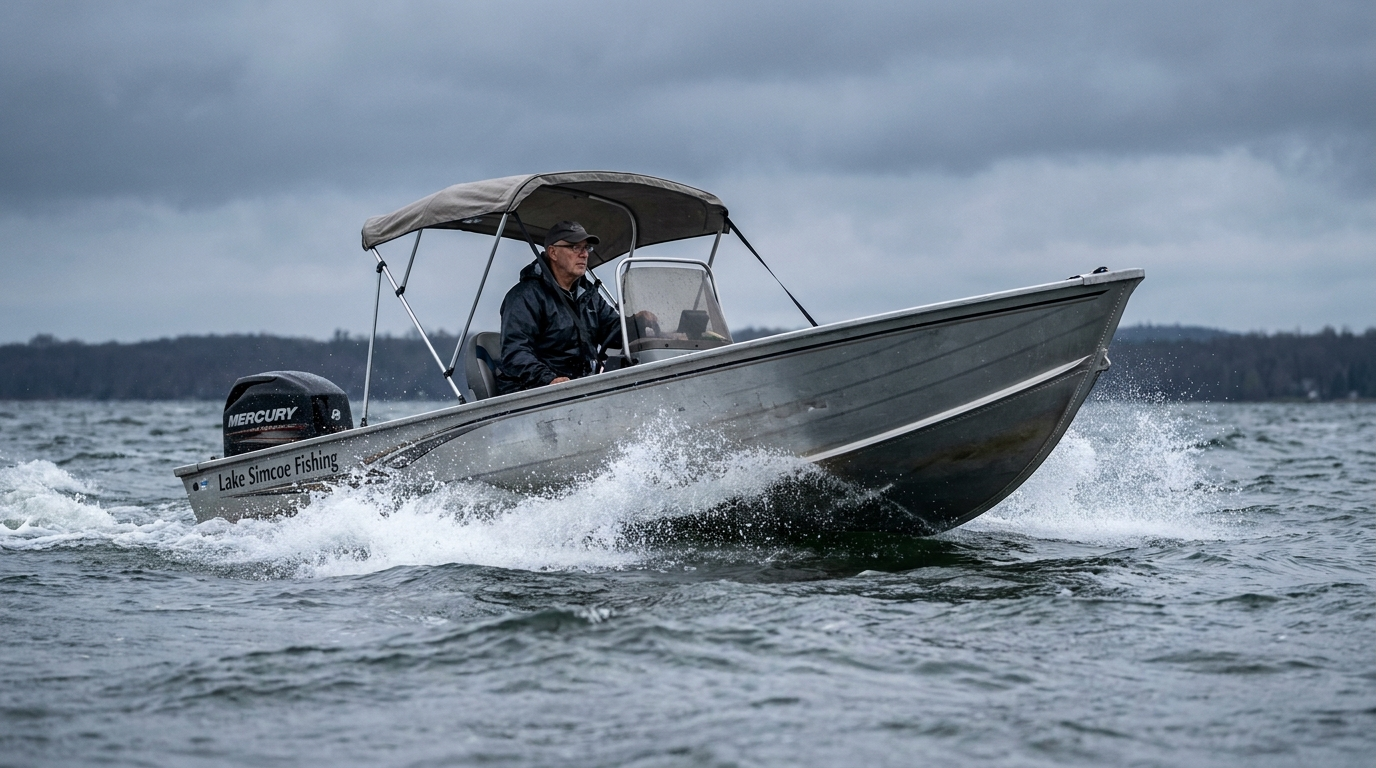
This is the big one. A pontoon in 2-foot chop is uncomfortable; in 3-foot chop it is downright unsafe. A V-hull cuts through the same waves with the bow shedding spray and the cockpit staying dry. On Lake Ontario, Lake Simcoe, or any of the bigger Kawartha lakes during a windy afternoon, the V-hull is the right tool.
Fishing as a focused activity
Anglers chasing walleye on a bigger lake, bass tournament fishing, or muskie hunting in deep water all benefit from the V-hull's ability to move fast between spots and handle rough water. The dedicated bass-boat and aluminum fishing-boat platforms are built around this use case. Our Bass Boat Buying Guide goes deeper on the dedicated angling setups.
Watersports
Tubing, water skiing, and wakeboarding need a hull that produces a usable wake and handles tight turning at speed. A pontoon can pull a tube respectably on calm water; a V-hull is the dedicated platform for the full range of watersports.
Speed and range
If your idea of a good Saturday is running 25 miles (40 km) to a different lake or town, the V-hull gets you there in less time on less fuel at planing speed. Pontoons cruise; V-hulls travel.
Smaller-package economy
A 16-18 foot aluminum V-hull with a 50-90 HP Mercury is one of the cheapest paths to capable on-water performance. The same dollar buys you a much smaller pontoon (16-foot pontoons exist but they are limited in capability).
Where the decision is genuinely close
For a lot of Ontario boaters, neither hull is "wrong." The decision comes down to lifestyle:
- Calm-water family weekends with occasional fishing: pontoon usually wins.
- Mixed use with kids learning to ski plus serious fishing: V-hull usually wins.
- Two-person fishing focus on Rice Lake / Pigeon / Sturgeon: V-hull (aluminum) usually wins on cost and capability.
- Cottage entertaining with mixed-age groups: pontoon usually wins.
- "I want a boat that does everything": a 19-22 foot tritoon with the right motor package gets you close on the calm-water side; a 19-foot deep-V runabout gets you close on the rough-water side. Neither does both.
How Rice Lake and the Kawarthas fit in
Rice Lake is a warm, shallow, fish-friendly lake. The maximum sustained chop on Rice Lake even in a windy afternoon is generally manageable for both hulls (occasionally 1-2 feet, rarely more). The Trent-Severn locks connecting the Kawarthas don't impose hull-type restrictions, but check your draft and the 6.1 m (20 ft) minimum fixed bridge clearance, including any canopy or bimini, with Parks Canada before you plan a trip.
For a Rice Lake primary boater who plans to occasionally trailer to bigger water (Lake Simcoe, Lake Ontario, larger Kawartha lakes during shoulder seasons), the V-hull buys flexibility. For a Rice Lake primary boater who plans to stay on Rice Lake and have people on the boat regularly, the pontoon is hard to beat.
Already own the boat? Then it's a power question, not a hull question
If you already have a pontoon or a V-hull you are happy with, the hull debate is settled. The real question is whether it is powered right for what you ask of it. A pontoon that is slow to plane with a full crew, or a V-hull that will not get out of its own way, is usually under-powered or propped wrong, not the wrong boat.
Build a quote at https://www.mercuryrepower.ca/quote/motor-selection.
What we actually sell at Harris Boat Works
We are a Legend Boats dealer, which gives us access to both their pontoon lineup (LE Series, Q Series, Halo) and their V-hull aluminum lineup (Pulse, R Series, XF, XT, Titanium). When customers come in undecided, we usually:
- Ask how many people are on the boat in a typical outing.
- Ask what bodies of water they use most often.
- Ask whether watersports are part of the plan.
- Test-drive whichever hull seems to fit, and sometimes the alternative too.
The Mercury power package is matched to the hull (Command Thrust gearcase for tritoons in the 90-115 HP range, check the exact gearcase on higher-powered models; standard gearcase or Pro XS for V-hulls depending on use). Either way, the right motor pairing matters as much as the hull choice.
About the author
Jay Harris helps run Harris Boat Works, a third-generation family marina in Gores Landing on Rice Lake, established in 1947. HBW is a Mercury Marine Premier Dealer and Legend Boats dealer serving Rice Lake, the Kawarthas, and Ontario boaters who want straight answers before spending real money. Read Jay's full bio.
Sources
- Legend Boats 2026 product specifications (legendboats.com)
- Mercury Marine outboard pairing guide (mercurymarine.com/ca/en)
- Transport Canada Pleasure Craft Safety Guide
- HBW dealer experience, 2018-2026 customer purchases
