--- > Quick answer: Mercury portables run 2.5 to 20 HP, light enough to carry, simple enough to maintain. The 9.9 is a common choice for cottage tin boats and small fishing rigs. Check the exact model for control type, shaft length, starting system, and installation requirements.
Quick answer: Mercury portables run 2.5 to 20 HP, light enough to carry, simple enough to maintain. The 9.9 is a common choice for cottage tin boats and small fishing rigs. Check the exact model for control type, shaft length, starting system, and installation requirements. Configure at mercuryrepower.ca.
Zeroing in on the 9.9? See our dedicated Mercury 9.9 tiller, kicker, and ProKicker guide for every variant and its CAD price.
Why portable motors are the right answer on small boats
Mercury portable outboards are simple, reliable, and well-suited to the most common small-boat applications in the Kawarthas: cottage tin boats, small fishing rigs, sailboat auxiliaries, and kicker setups on bigger boats.
The 9.9 MH in particular is something we sell in volume at HBW every year. It's the workhorse of the Canadian small-boat segment, you bolt it to the transom, attach the fuel line, pull the rope, and go fishing. No rigging. No console. No controls to run. It just works.
What changes the right portable Mercury for your application
Boat size and weight. A 12-foot tin boat needs less HP than a 14-foot heavy-duty aluminum fishing rig.
Use case. Solo fishing is different from a sailboat auxiliary, which is different from a kicker on a bigger boat. The right choice for each varies.
Storage and transport. Smaller portables (under 15 HP) are genuinely hand-carry portable. Larger portables (15–20 HP) are tiller-friendly but heavier, easier with two people.
Manual vs. electric start. Manual (rope pull) saves money and weight. Electric start adds convenience at a cost premium and requires a battery.
Shaft length. Most small boats need short shaft (15 inches). Sailboats and deeper transoms need long shaft (20 inches). Getting this wrong causes problems, cavitation if too short, drag if too long.
The Mercury portable lineup
Mercury 2.5 MH (2.5 HP)
Very small dinghies, ultralight applications. 1-cylinder 4-stroke, manual start.
Mercury 3.5 MH (3.5 HP)
Small dinghies, sailboat auxiliaries, very small fishing boats. A common choice for sailor-auxiliary use.
Mercury 5 MH and 6 MH
8 to 11-foot small boats. Lightweight and portable.
Mercury 9.9 MH (9.9 HP)
12–14-foot tin boats, kicker motors on bigger boats. A common cottage fishing and small-boat choice. 2-cylinder 4-stroke, manual start.
Note: The 9.9 ProKicker is a different, purpose-built fishing kicker variant, see the ProKicker guide for that specific application.
Portable Mercury sizing
What are you actually pushing?
The portable Mercury lineup covers a wide range of jobs. The right choice depends less on the hull and more on what role the motor plays.
Dinghy, canoe, or small jon boat
- ✓Tender for a larger boat at anchor
- ✓Solo or two-person fishing on a small pond or river
- ✓Boat under 12 feet, light aluminum or inflatable
- ✓Want one-hand carry and easy stowage
Mercury 2.5 to 6 HP MH
Small fishing boat or backup kicker
- ✓14 to 16 foot aluminum used regularly
- ✓Trolling for walleye or bass on Kawartha lakes
- ✓Backup or kicker for a larger main motor
- ✓Need electric start with tiller controls
Mercury 9.9 to 20 HP EH or ELH
When in doubt:A 9.9 EFI is often the more versatile motor in this range when the hull, load, and carrying weight allow it. A 5 HP can be the right call on a lighter dinghy or jon boat that must stay easy to lift. Match horsepower to hull, load, and how you will carry the motor.
Mercury 15 MH and 15 EH (15 HP)
14-foot tin boats, slightly larger small fishing applications. Available in manual or electric start.
Mercury 20 EH (20 HP)
Larger tin boats with tiller layouts. Electric start. Choose a remote-control configuration separately for a console helm. The top of the portable range, more boat-moving capability, meaningfully heavier.
Manual vs electric start
Manual start (MH models):
- Lower cost, typically a meaningful saving over electric start
- Lower weight, no battery, no starter motor
- Simpler, fewer parts to fail
- No battery maintenance over winter
Electric start (EH models):
- Easier for operators who prefer not to rope-pull
- More convenient for older operators or when physical access to the pull start is awkward
- Requires a battery and ongoing maintenance
For most small fishing applications, manual start (MH) is fine. For older operators or when convenience matters more than weight and cost, electric start (EH) is worth the premium.
Shaft length
Short shaft (15 inches): Standard for most tin boats and small dinghies.
Long shaft (20 inches): Required for sailboat auxiliaries, deeper transoms, some larger small boats.
Wrong shaft length is the most common portable motor mistake. If the shaft is too short for the transom, the motor cavitates at speed. Too long and the lower unit drags unnecessarily deep.
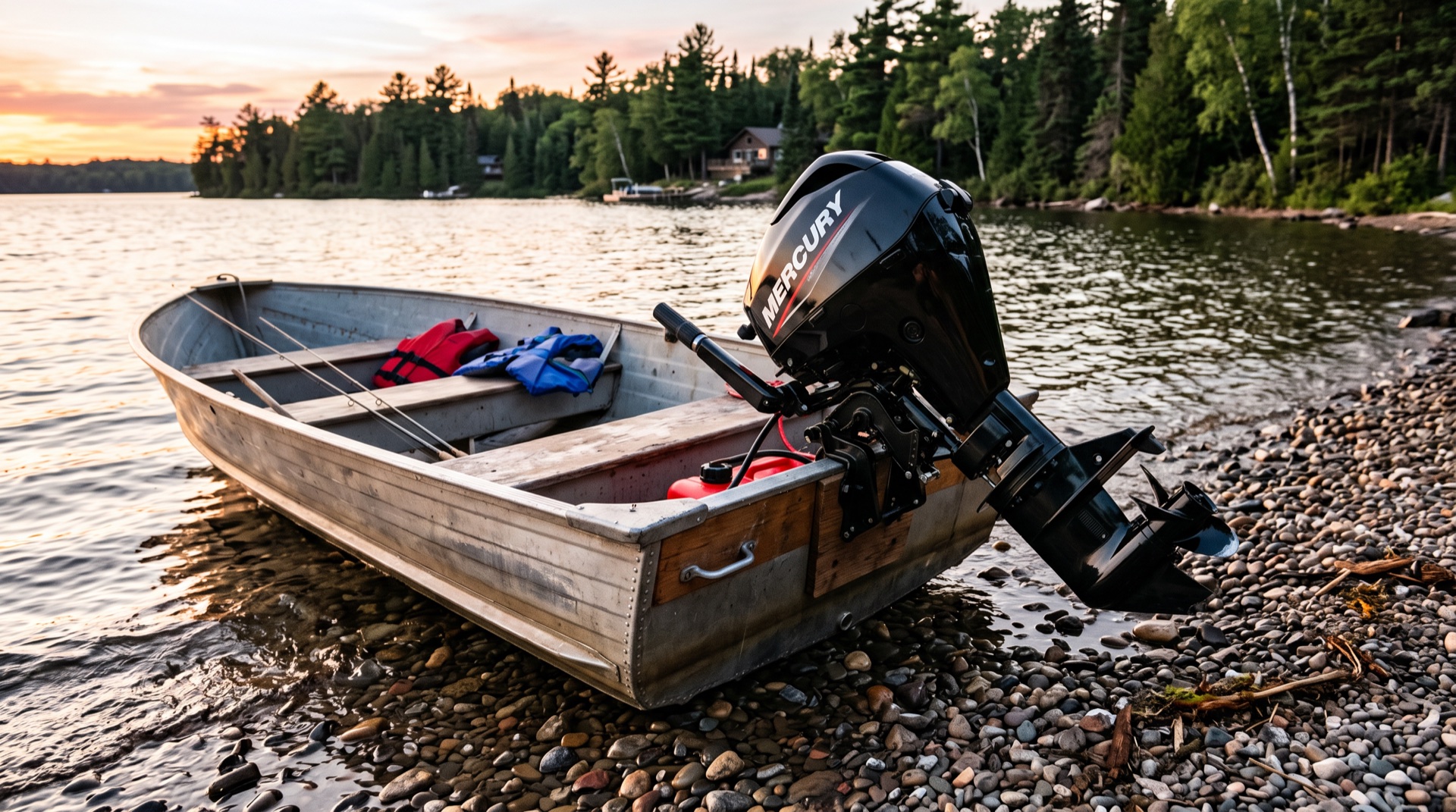
At HBW, we measure transom depth before recommending shaft length on any portable motor sale. If you're buying a drop-in install for a boat you know well, measure transom depth yourself. Use the exact model's installation manual to set the anti-ventilation plate height. For example, Mercury's 2.5/3.5 and 4/5/6 FourStroke manuals specify 25–50 mm (1–2 inches) below the boat bottom; the 15/20 EFI manual specifies level with to 25 mm (1 inch) below it. Air drawn from the surface is ventilation, often loosely called cavitation.
Storage and transport
Portable motors are designed for easy transport, but they need proper care:
- Storage: Use a motor stand or wall mount. Horizontal storage is okay with the correct orientation, check the owner's manual.
- Transport: Most portables under 15 HP are one-person carry with the built-in handle. 15+ HP models are easier with two people.
- Fuel: Drain the system or add fuel stabilizer if the motor will sit unused for more than a month. Untreated fuel gums up carburetors.
- Mounting: Check the mounting hardware before every launch. Tight clamps alone are not enough on the 8/9.9 FourStroke and 15/20 EFI families covered by Mercury's manuals: the bracket must also be bolted through the transom as specified. Follow the exact model's mounting and safety-retention instructions.
Common portable motor mistakes
1. Wrong shaft length. The single most preventable mistake. Measure before you buy.
2. Buying too small for the boat. A 5 HP on a 14-foot tin boat with two anglers is underpowered. Right-size for actual loading.
3. Skipping fuel stabilizer. Portable motors sit unused for stretches. Untreated fuel creates carburetor problems.
4. Skipping break-in. Follow the exact engine's break-in procedure; early throttle limits differ from larger Mercurys. The 2.5/3.5, 4/5/6, 8/9.9 FourStroke and 15/20 EFI manuals describe a 10-hour break-in with different limits for the first hour, second hour and remaining eight hours. Read those limits before the first launch.
5. Loose or incomplete mounting hardware. Check clamps and required mounting bolts before every launch. Clamp screws do not replace the through-bolts specified for the applicable 8 to 20 HP models.
Sources and review notes
Installation and break-in examples were checked against Mercury's 2.5/3.5 FourStroke manual, 8M0114066 (December 2015), 4/5/6 manual, 8M0114067 (December 2015), 8/9.9 manual, 8M0114069 (December 2015), and 15/20 EFI manual, 8M0145520 (April 2018). Match the manual to your engine model and serial; these examples do not establish every current configuration.
Ready to buy a portable Mercury?
Build a quote at mercuryrepower.ca, live pricing in CAD on the full portable range.
