--- > Quick answer: Tiller is right when you sit at the transom: open tins, kicker motors, and solo fishing. Remote is right when the operator is at a helm: console boats, family use, and long runs with passengers.
Quick answer: Tiller is right when you sit at the transom: open tins, kicker motors, and solo fishing. Remote is right when the operator is at a helm: console boats, family use, and long runs with passengers. Length and horsepower overlap, so use helm layout and how you actually run the boat. Configure either at mercuryrepower.ca.
Mercury control type decision
Tiller-steer or remote-helm Mercury?
More than just where the stick goes. The tiller-vs-remote decision changes how you fish, how you drive, and how you trailer. Here's how to pick.
Tiller-steer
- ✓You fish solo or 1-2 people and want to spot-cast from the back of the boat
- ✓You run a 14-18 ft aluminum tin boat (Lund WC, Princecraft Holiday, Legend Tin)
- ✓You like having open deck space in the front of the boat
- ✓You don't need bilge gauges, fancy electronics, or a wheel
- ✓20 to 60 HP sweet spot; Advanced Tiller available up to 115 HP
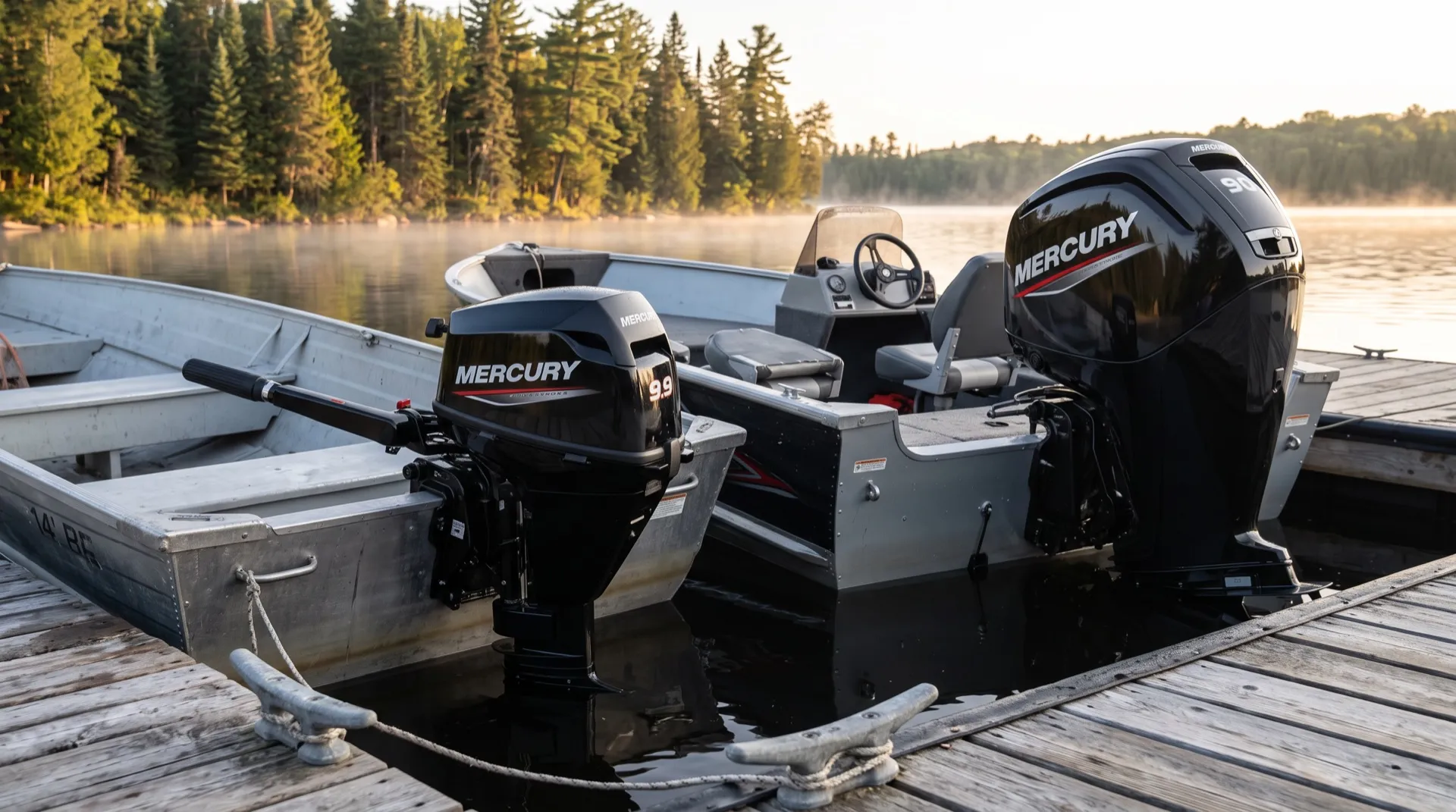
Cheapest, lightest, fewer parts to break. Perfect for back-trolling and casting. Mercury 20-60 HP tiller. Motor price is only the starting point; controls, rigging, and labour are quoted separately.
Remote helm
- ✓You run with passengers, family, or kids who need a windshield to hide behind
- ✓You're 16-22+ ft and want gauges, electronics, livewell controls at your fingertips
- ✓You go further from the launch and value sitting forward at speed
- ✓You want power steering, hydraulic trim, SmartCraft displays
- ✓60 HP and up, especially 90 HP+
More comfortable, more capable, more expensive. Mercury 90 HP remote with mechanical controls. Motor price is only the starting point; controls, rigging, and labour are quoted separately, and a full SmartCraft or hydraulic package adds more.
When in doubt:If your boat has a built-in console with windshield, you want remote. If your boat is a tin with bench seats and no console, you want tiller. The middle case (14-16 ft with console) goes either way; we usually push remote on those, because it ages better as kids and gear pile in.
Tiller vs remote steering at a glance
| Factor |
Tiller |
Remote (helm) |
| Best hull length |
14-18 ft aluminum |
16-22 ft+ |
| HP range |
20-60 HP sweet spot; Advanced Tiller available up to 115 HP |
60 HP+, especially 90 HP+ |
| Price (Mercury) |
Bare motor from the live pricing reference; controls, rigging, and labour quoted separately |
Bare motor from the live pricing reference; controls, rigging, labour, and any SmartCraft or hydraulic package quoted separately |
| Steering |
Direct, reverse-intuitive |
Cable or hydraulic: match the approved system to the boat and engine; hydraulic adds roughly $800-$1,500 |
| Best for |
Solo / back-of-boat fishing, trolling |
Family, passengers, bigger water |
| Rice Lake, Ontario pick |
60 HP EFI tiller (standard gearcase); ProKicker 9.9 |
90-115 HP remote |
| Tiller-to-remote conversion |
$500-$1,500+ parts + labour |
- |
Prices here are planning figures as of October 2026. For live Mercury motor pricing, see the Mercury pricing reference.
The simple version
Most small boats want tiller. Most bigger boats want remote control. The question isn't complicated unless you're in the crossover zone, which is 14 to 16-foot hulls in the 25 to 40 HP range.
We sell both configurations at HBW. The decision comes down to honest analysis of how you use the boat. Solo fishing where you sit in the back wants tiller. Family fishing where the operator is at the helm wants remote. Crossover cases are where it gets harder.
What changes the answer
Helm layout. If the boat already has a console, the helm is where the operator belongs and remote is the usual match. An open tin with bench seats and no console usually wants tiller.
How you handle the boat. Solo fishing from the transom wants tiller. Family use, passengers, and talking to people at the bow want remote.
Normal use and workload. Small portable motors and kickers are typically tiller. Higher-HP mains that run long days at speed are usually remote because the handle becomes work. Some 60 HP tiller configurations exist for specific applications.
Length is only a clue. A 16-foot tin fished solo can stay tiller; a 16-foot console boat usually wants remote. Use the helm and how you actually run the boat, not a length cutoff.
Personal preference. Some experienced solo anglers prefer the direct feel of tiller even on bigger boats. It's a legitimate call.
When tiller is clearly right
- Small tin boats (10–14 ft) without a console
- Solo fishing where the operator sits at the back
- Kicker motors on bigger boats, the 9.9 ProKicker tiller is the classic walleye setup on Rice Lake
- Sailboat auxiliaries
- Dinghies and yacht tenders
The clear no for tiller:
- Console boats over 16 ft, the helm exists; tiller is awkward from it
- Family boats where the captain needs to talk to people up front
- Higher HP motors (above about 60 HP) where the tiller becomes physically demanding
When remote control is clearly right
- Console boats over 16 ft, standard configuration
- Family fishing and recreation
- Bigger HP main motors (90+ HP)
- Pontoons, the helm seat and remote control is the standard pontoon configuration
- Any boat with a hardtop or T-top where the helm is away from the transom
The clear no for remote:
- Very small boats (10–14 ft) without a console, adds cost and complexity for no functional gain
- Kicker applications where direct tiller control is preferred
- Sailboat auxiliaries where remote rigging is unnecessarily complex
The crossover zone: 14–16 ft hulls, 25–40 HP
This is where it gets honest:
Tiller advantages in this size class:
- Lower total cost, no rigging cables, no helm controls
- Simpler installation, drop-in vs. full rigging
- Direct fishing control for solo or two-person use
- Lighter overall weight
Remote advantages in this size class:
- Better passenger interaction, captain can talk to people up front
- More comfortable for long runs, sit at the helm vs. crouch at the transom
- Better visibility from the helm position
- Standard expectation for family-oriented boats in this size
We see customers go either way on this size class. The deciding factor is almost always use case, solo fishing often stays tiller; family use usually goes remote.
Tiller variants
Standard tiller: Manual or electric start. Throttle and shift integrated into the tiller arm. Standard on portable Mercury motors.
Power tiller: Power tilt/trim assist via a switch on the tiller handle. Common on bigger tiller motors (40+ HP). Adds cost but reduces operator effort, worth it on motors you're running for long periods.
High-thrust tiller (ProKicker variants): Built specifically for fishing kicker applications. High-thrust gearcase, larger prop, longer shaft for big-boat transoms. See the ProKicker guide for details.
Remote control variants
Mechanical remote control: Cable-driven throttle and shift. Steering is a separate system; a motor with mechanical throttle and shift can use an approved cable or hydraulic steering setup.
Digital Throttle and Shift (DTS): Electronic throttle and shift, no cable wear, smoother operation. Available on higher-HP Mercury motors (generally 150 HP and up). More refined feel.
Cable vs hydraulic steering:
- Cable: Check the exact helm and cable system against its manufacturer's application limits. Horsepower alone does not establish suitability.
- Hydraulic: Choose a compatible cylinder, helm and hose package for the engine and boat. Compare steering effort and handling with the approved cable alternatives.
- Power-assist: Available on some high-HP applications. Easiest feel, most refined.
We rig both at HBW. Specific recommendations depend on motor HP and how you use the boat.
Common mistakes
Buying tiller for a console boat. The console exists for the helm. Driving a console boat from the transom is awkward every single trip.
Planning to "convert later." The conversion runs $500-$1,500+ in parts and labour. Speccing remote at repower time is always cheaper.
Going tiller on more horsepower than your arm wants. Above 60 HP, a full day on the handle is work. That's remote territory for most people.
Ready to choose?
Build a quote at mercuryrepower.ca, live pricing in CAD with full configuration options for both tiller and remote.